How to Find Valence Electrons on the Periodic Table
Find valence electrons from the group number in seconds. Worked examples for sulfur, sodium and chlorine, the transition metal catch, and an interactive periodic table.
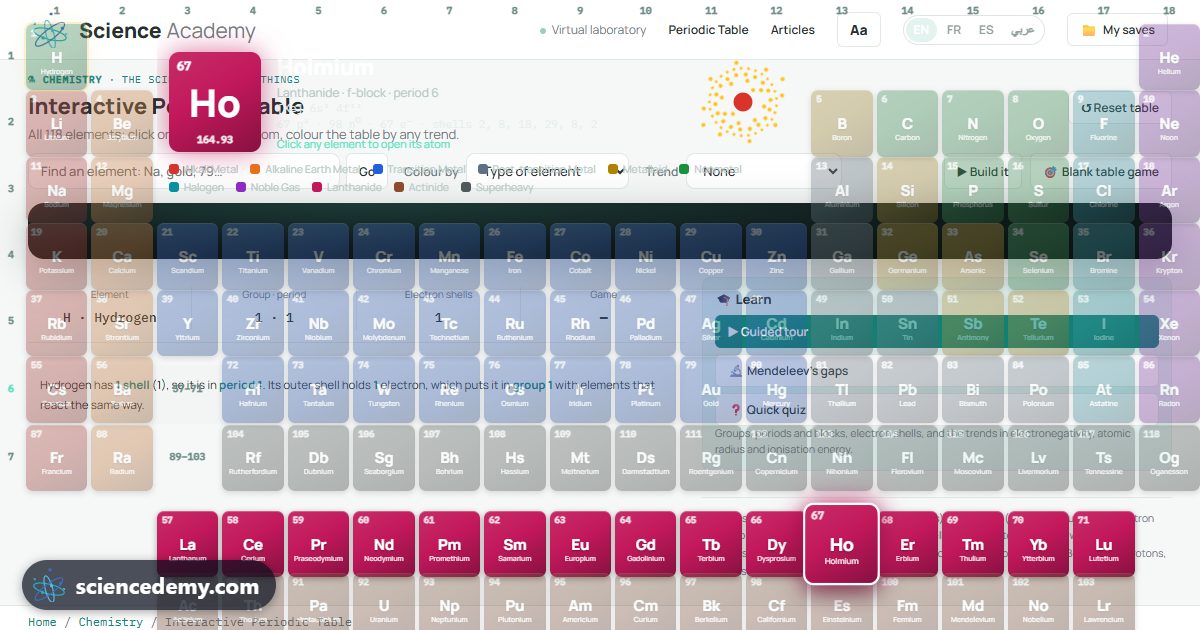
How to find valence electrons: look at the element's group number on the periodic table. Elements in groups 1 and 2 have 1 and 2 valence electrons; elements in groups 13 to 18 have the group number minus 10 (so group 16 has 6). Helium is the one exception in the main groups: it sits in group 18 but has only 2. Transition metals (groups 3 to 12) don't follow this simple rule.
What are valence electrons?
Valence electrons are the electrons in an atom's outermost shell. They are the ones that take part in chemical reactions: atoms lose, gain or share them to form bonds. Because elements in the same group have the same number of valence electrons, they react in similar ways. That is why sodium and potassium (both 1 valence electron) both fizz in water, and why fluorine and chlorine (both 7) both form ions with a charge of −1.
The inner electrons, called core electrons, sit closer to the nucleus and are held too tightly to take part in ordinary reactions.
How do you find valence electrons from the group number?
Use the group number at the top of each column. This works for every element in the main groups (the s-block and p-block):
| Group | Valence electrons | Example | Common ion |
|---|---|---|---|
| 1 | 1 | Sodium, Na | Na⁺ |
| 2 | 2 | Magnesium, Mg | Mg²⁺ |
| 13 | 3 | Aluminium, Al | Al³⁺ |
| 14 | 4 | Carbon, C | (shares electrons) |
| 15 | 5 | Nitrogen, N | N³⁻ |
| 16 | 6 | Sulfur, S | S²⁻ |
| 17 | 7 | Chlorine, Cl | Cl⁻ |
| 18 | 8 (helium 2) | Neon, Ne | none |
This table is a quick valence electrons chart for the main groups, so finding valence electrons on the periodic table takes one glance at the column. The column numbers 13 to 18 come from the modern 18-column table; older textbooks number them III to VIII, which gives the valence electrons directly.
Worked example: how many valence electrons does sulfur have?
Sulfur (S) is element 16. It sits in group 16, so it has 16 − 10 = 6 valence electrons. You can check this with its electron shells: sulfur has 16 electrons arranged 2, 8, 6. The last number, 6, is the outer shell. Sulfur needs two more electrons to fill that shell, which is why it forms the sulfide ion, S²⁻.
Worked example: sodium and chlorine
Sodium (Na, element 11) is in group 1: 1 valence electron, shells 2, 8, 1. Chlorine (Cl, element 17) is in group 17: 7 valence electrons, shells 2, 8, 7. When they react, sodium gives its single outer electron to chlorine. Both end up with full outer shells, and you get the ions Na⁺ and Cl⁻ in sodium chloride.
How do you find valence electrons from the electron configuration?
The electron configuration lists how electrons fill the subshells. To count valence electrons, add up the electrons in the highest-numbered shell (the largest first number):
- Write the configuration, e.g. phosphorus: 1s² 2s² 2p⁶ 3s² 3p³.
- Find the highest shell number: here it is 3.
- Add the electrons in that shell: 3s² + 3p³ = 2 + 3 = 5 valence electrons.
The shorthand with a noble gas core makes this faster. Phosphorus is [Ne] 3s² 3p³: everything after the bracket in the outer shell counts. The period number tells you which shell is the outer one, because the period (row) equals the number of occupied shells.
Why don't transition metals follow the rule?
For the transition metals (the d-block, groups 3 to 12), the outer electrons are spread over two shells. Iron, for example, is [Ar] 4s² 3d⁶: it has 2 electrons in its outermost shell (4s), but the 3d electrons are close in energy and can also take part in bonding. That is why iron forms both Fe²⁺ and Fe³⁺ ions.
So for transition metals there is no single "valence electrons" number from the group. Most have 2 electrons in their outermost s-subshell; a few, such as chromium ([Ar] 4s¹ 3d⁵) and copper ([Ar] 4s¹ 3d¹⁰), have just 1. The lanthanides and actinides (the f-block) are similar.
What does the number of valence electrons tell you?
- Reactivity: atoms with 1 or 7 valence electrons are the most reactive, because they are one electron away from a full shell. Atoms with a full shell (the noble gases) hardly react at all.
- Ion charge: metals lose their valence electrons (group 2 → 2+), and non-metals gain enough to reach 8 (group 15 → 3−).
- Bonding: carbon's 4 valence electrons let it form 4 covalent bonds, which is the basis of organic chemistry.
- Lewis structures: the dots around each symbol in a Lewis structure are its valence electrons.
Common mistakes
- Using the group number for groups 13 to 18 without subtracting 10. Chlorine does not have 17 valence electrons; it has 7.
- Counting all the electrons. The atomic number gives the total; only the outer shell counts.
- Forgetting helium. It is in group 18 but has a full first shell of only 2.
- Treating transition metals like main-group elements. Their group number does not equal their valence electrons.
- Counting the last subshell instead of the last shell. For gallium, [Ar] 4s² 3d¹⁰ 4p¹, the valence electrons are 4s² 4p¹ = 3, not just the 4p¹.
Frequently asked questions
How many valence electrons does oxygen have?
Oxygen has 6 valence electrons. It is element 8, in group 16, so its electrons are arranged 2, 6: two in the first shell and six in the outer shell. It needs two more to fill its outer shell, so it usually forms two covalent bonds (as in water, H₂O) or the oxide ion, O²⁻, with a charge of 2−.
Do all elements in a group have the same number of valence electrons?
Yes, for the main groups (1, 2 and 13 to 18). That is what defines a group, and it is why elements in a group react in similar ways. Lithium, sodium and potassium all have 1 valence electron and all react with water to make hydrogen. The one exception is helium, which has 2 valence electrons but is placed in group 18 because its shell is full, like the other noble gases.
What is the maximum number of valence electrons?
For main-group elements the maximum is 8, a full outer shell of s² p⁶. This is the "octet" that atoms tend to reach by losing, gaining or sharing electrons. Only the noble gases (except helium) have 8 valence electrons as neutral atoms, which is why they are so unreactive.
How do you find valence electrons for ions?
Start from the neutral atom and add or remove electrons. A sodium ion, Na⁺, has lost its single valence electron, so its new outer shell is the full second shell with 8 electrons (2, 8). A chloride ion, Cl⁻, has gained one, giving 8 valence electrons (2, 8, 8). Most simple ions end up with a full outer shell.
Try it yourself
Open the interactive periodic table and set Trend to Valence electrons: every main-group tile shows its number, and the colours change across each period but stay the same down each group. Click sulfur to open its atom and count the 6 electrons in the outer shell, then play the blank table game to place elements using their shells and outer electrons. Each element also has its own page, such as sulfur, with its Bohr model. For how ions form from valence electrons, read how do ions form.
Véalo por sí mismo, en 3D y gratis.
Pruébalo en el Interactive Periodic Table