Types of Plate Boundaries: Diagrams and Examples
The three types of plate boundaries are convergent, divergent and transform. See what happens at each, the landforms they make, real examples and why earthquakes occur.
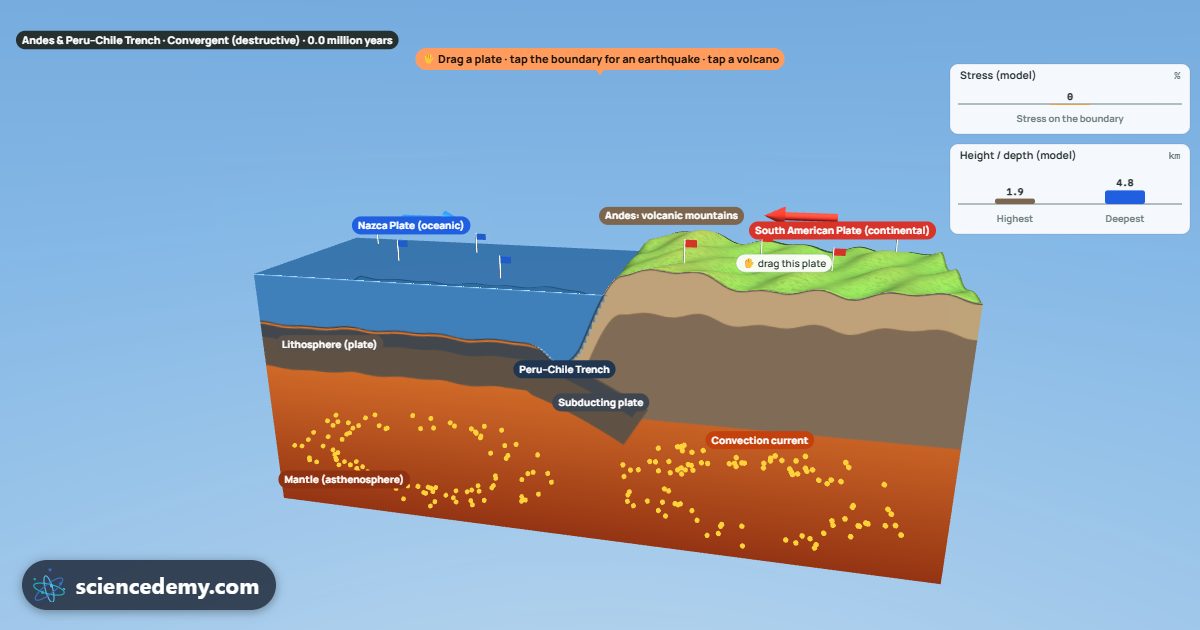
There are three types of plate boundaries: convergent (destructive) boundaries, where two plates move towards each other; divergent (constructive) boundaries, where they move apart; and transform (conservative) boundaries, where they slide past each other. Each type makes its own landforms: convergent boundaries build mountains, trenches and volcanoes, divergent ones make ridges and rift valleys, and transform faults cause powerful earthquakes.
What is plate tectonics theory?
Plate tectonics theory says the Earth's outer shell, the lithosphere, is broken into about a dozen large tectonic plates and many smaller ones. The plates float on the hotter, softer asthenosphere of the upper mantle and move a few centimetres a year, roughly as fast as your fingernails grow. Heat from the Earth's core drives slow convection currents in the mantle, and the pull of cold, dense plate sinking at trenches (slab pull) does much of the work of dragging plates along.
There are two kinds of plate. Oceanic crust is thin (about 7 km) and dense, made of basalt. Continental crust is thicker (30–70 km) and lighter, made mostly of granite. That difference in density decides what happens when plates meet.
What happens at plate boundaries?
Plates are rigid, so almost all the action happens at their edges. Stress builds up where they push, pull or grind against each other, and it is released in earthquakes, volcanic eruptions and the slow growth of mountains.
| Boundary | Plate movement | Also called | Landforms | Example |
|---|---|---|---|---|
| Convergent | Towards each other | Destructive | Trenches, fold mountains, volcanoes | Andes, Himalayas, Mariana Trench |
| Divergent | Apart | Constructive | Mid-ocean ridges, rift valleys | Mid-Atlantic Ridge, East African Rift |
| Transform | Side by side | Conservative | Fault lines, offset rivers | San Andreas Fault |
What are convergent, divergent and transform boundaries?
The three types of boundary differ in which way the plates move, and convergent boundaries split further depending on which kinds of crust meet.
Convergent boundaries
At a convergent boundary two plates collide. What happens next depends on the crust:
- Oceanic–continental: the denser oceanic plate sinks under the continent. This is subduction. It forms a deep ocean trench offshore, and water released from the sinking plate melts the mantle above it, feeding a chain of explosive composite volcanoes. The Nazca Plate is subducting under South America at about 7 cm a year, building the Andes.
- Oceanic–oceanic: the older, colder plate subducts under the other, forming a trench and an arc of volcanic islands. The Mariana Trench, about 11 km deep, is the deepest point in any ocean.
- Continental collision: neither plate is dense enough to sink, so the crust crumples and thickens into fold mountains. India colliding with Asia raised the Himalayas, including Everest at 8,849 m.
Subduction zones produce the largest earthquakes on Earth. The 1960 Chile earthquake, magnitude 9.5, is the strongest ever recorded.
Divergent boundaries
At a divergent boundary plates pull apart, the pressure on the mantle beneath drops, and it partly melts. Magma rises to fill the gap and cools into new crust, which is why these boundaries are called constructive. Under the sea this builds a mid-ocean ridge: the Mid-Atlantic Ridge runs the length of the Atlantic, which widens by about 2.5 cm a year. Iceland sits on top of it. On land, a divergent boundary tears a continent apart to make a rift valley, such as the East African Rift.
Volcanoes here erupt runny basalt gently, forming shield volcanoes and lava fields rather than explosive cones (see parts of a volcano for why magma type matters).
Transform boundaries
At a transform boundary plates slide past each other sideways. No crust is made or destroyed, so they are called conservative, and there are no volcanoes. The plates lock together by friction, stress builds for decades, then the rock suddenly slips in an earthquake. The San Andreas Fault in California is the best-known example: the 1906 San Francisco earthquake, magnitude 7.9, happened when it slipped by up to 6 m.
How do we know the plates move?
The clearest evidence came from the sea floor. In 1963 Fred Vine and Drummond Matthews explained the magnetic stripes found either side of mid-ocean ridges. As new basalt cools at the ridge, iron minerals line up with the Earth's magnetic field, which flips every few hundred thousand years. The result is a mirror-image pattern of stripes on both sides of the ridge, showing that new crust forms in the middle and moves outwards. Other evidence includes:
- the jigsaw fit of South America and Africa, first argued by Alfred Wegener in 1912;
- matching fossils and rock types on continents now separated by oceans;
- sea-floor rock getting older with distance from the ridges;
- GPS measurements that track plate speeds directly today.
Common mistakes
- Saying continental crust subducts. It is too light to sink far; when two continents meet, they fold up into mountains instead.
- Thinking plates float on a liquid mantle. The mantle is solid rock that flows very slowly, like extremely stiff putty.
- Putting volcanoes at transform boundaries. Transform faults make earthquakes but not volcanoes, because no magma is produced.
- Mixing up the names. Destructive = convergent, constructive = divergent, conservative = transform.
Frequently asked questions
What are the 3 types of plate boundaries?
The three types of plate boundaries are convergent, divergent and transform. At a convergent (destructive) boundary, plates move towards each other and one may sink beneath the other, making trenches, volcanoes and mountains. At a divergent (constructive) boundary, plates move apart and magma rises to form new crust at ridges and rift valleys. At a transform (conservative) boundary, plates slide past each other, causing earthquakes along faults like the San Andreas.
Which plate boundary causes the biggest earthquakes?
Convergent boundaries with subduction cause the biggest earthquakes. Where an oceanic plate sinks under another plate, a huge area of the two plates locks together and stores strain for centuries. When it finally slips, the earthquake can exceed magnitude 9, like Chile in 1960 (magnitude 9.5). These are called megathrust earthquakes, and because they lift the sea floor they often set off tsunamis.
Why are there no volcanoes at transform boundaries?
Transform boundaries have no volcanoes because no rock melts there. Volcanoes need magma, which forms when the mantle melts, either because water is added (at subduction zones) or because pressure drops (where plates pull apart). At a transform boundary the plates only slide sideways past each other, so neither happens. Instead, the stress is released as earthquakes when the locked fault suddenly slips.
How fast do tectonic plates move?
Tectonic plates move between about 1 and 10 centimetres a year. The Atlantic Ocean widens by about 2.5 cm a year, and the Nazca Plate moves towards South America at about 7 cm a year. That sounds tiny, but over 100 million years 2.5 cm a year adds up to 2,500 km, enough to open a whole ocean. Scientists now measure these speeds directly with GPS.
Try it yourself
Open the plate tectonics tool and choose a boundary: start with Oceanic–continental, press ▶ Watch it and see the trench form and the volcanoes rise. Switch on Mantle convection and Earthquake foci to see where the quakes happen along the sinking plate, then try Mid-ocean ridge and Transform fault and press 💥 Earthquake to compare them. Use ⏪ Rewind to run time backwards. To look inside the volcanoes that subduction builds, open the volcano tool, and see how the water those volcanoes release moves around the planet in the water cycle tool.
Véalo por sí mismo, en 3D y gratis.
Pruébalo en el Plate Tectonics