Conservation of Momentum Explained, With Worked Examples
Momentum is always conserved in a collision, p = mv. Learn the momentum formula, elastic and inelastic collisions, and how to calculate momentum with worked examples.
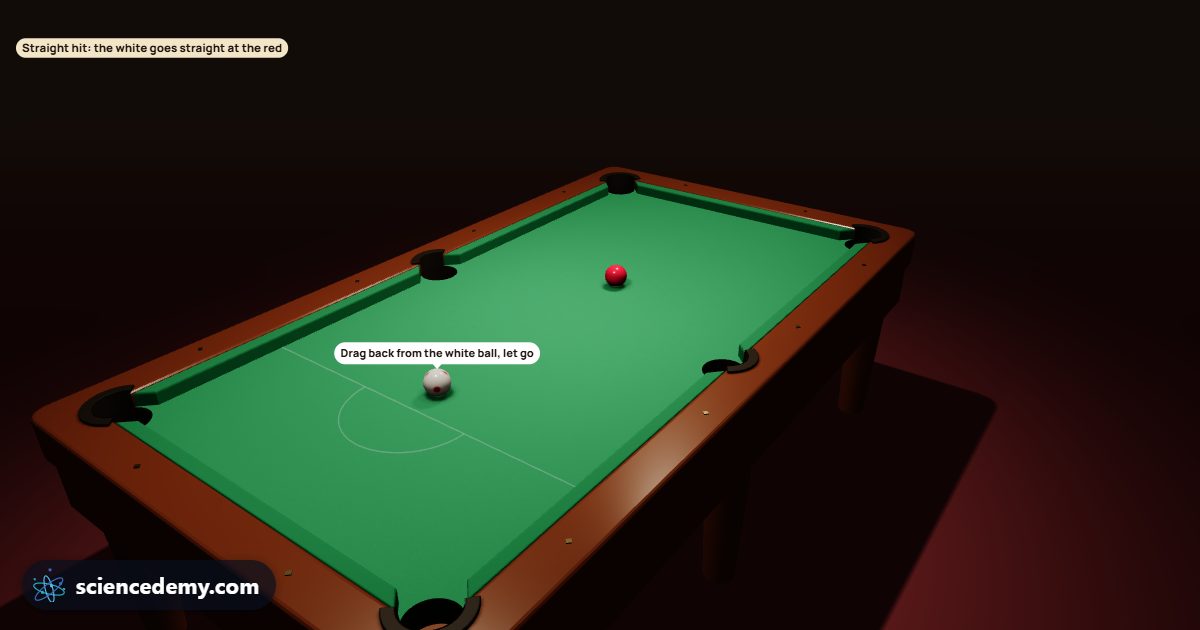
The law of conservation of momentum says that the total momentum of a system stays the same before and after a collision, as long as no outside force acts on it. Momentum (p) is mass times velocity, p = mv, measured in kilogram metres per second (kg m/s). If a 2 kg ball moving at 3 m/s hits a stationary 1 kg ball, the total momentum of 6 kg m/s is still 6 kg m/s afterwards, however the two balls end up moving.
What is momentum?
Momentum is a measure of how hard it is to stop something moving. It depends on both mass and velocity: a slow lorry and a fast tennis ball can have similar momentum, because the lorry's huge mass makes up for its low speed.
- The momentum formula is p = mv, where p is momentum (kg m/s), m is mass (kg), v is velocity (m/s).
- Momentum is a vector: it has a direction as well as a size. Two objects moving towards each other have momenta in opposite directions, so one is effectively negative when you add them.
- A stationary object has zero momentum, however large its mass.
What is the law of conservation of momentum?
In any collision or explosion, total momentum before = total momentum after, provided no external force (like friction from outside the system) acts during the event. Internal forces — the push the two objects exert on each other during the collision — always come in equal and opposite pairs (Newton's third law), so they cancel out and can never change the system's total momentum.
As a formula, for two objects colliding:
m₁u₁ + m₂u₂ = m₁v₁ + m₂v₂
where u is velocity before the collision and v is velocity after.
How to calculate momentum
Here's how to calculate momentum before and after a collision, worked through a real example.
Worked example: a snooker break
A cue ball of mass 0.16 kg travels at 2 m/s and strikes a stationary red ball of the same mass head-on. After the collision the cue ball stops dead and the red ball moves off.
Momentum before = momentum after:
0.16 × 2 + 0.16 × 0 = 0.16 × 0 + 0.16 × v
0.32 = 0.16v, so v = 2 m/s
The red ball leaves with the same speed the cue ball arrived with — the classic "stun shot" snooker players rely on, and exactly what the law predicts.
Elastic vs inelastic collisions
Elastic and inelastic collisions both conserve momentum. What changes between the two is whether kinetic energy is conserved too.
| Elastic collision | Inelastic collision | |
|---|---|---|
| Momentum | Conserved | Conserved |
| Kinetic energy | Conserved | Not conserved (lost as heat, sound, deformation) |
| Objects after | Separate, bounce apart | Often separate but slower, or stick together |
| Example | Snooker balls, gas molecules | Car crash, a ball of clay hitting a wall |
A perfectly inelastic collision is the extreme case where the objects stick together and move as one afterwards.
Worked example: a perfectly inelastic collision
A 1200 kg car travelling at 15 m/s crashes into a stationary 1000 kg car and they lock together.
Momentum before = momentum after:
1200 × 15 + 1000 × 0 = (1200 + 1000) × v
18000 = 2200v, so v ≈ 8.2 m/s
Check the kinetic energy: before the crash it's ½ × 1200 × 15² = 135,000 J; afterwards it's ½ × 2200 × 8.2² ≈ 74,000 J. More than 60,000 J has gone into crumpling metal and heat — momentum stayed the same, but kinetic energy clearly didn't.
How does the coefficient of restitution describe a collision?
The coefficient of restitution (e) measures how "bouncy" a collision is, from 0 (perfectly inelastic, objects stick) to 1 (perfectly elastic, no kinetic energy lost). It's defined as the ratio of the relative speed of separation to the relative speed of approach:
e = (v₂ − v₁) / (u₁ − u₂)
A game of snooker is close to e = 0.95; a collision between two balls of modelling clay is close to e = 0.
Why do rockets and guns recoil?
Recoil is conservation of momentum in action. Before a gun fires, the bullet and gun are both stationary, so total momentum is zero. The expanding gas pushes the bullet forwards and the gun backwards with equal and opposite momentum, so the total stays zero: m_bullet × v_bullet = m_gun × v_recoil. Because the gun's mass is much larger than the bullet's, its recoil velocity is much smaller — which is why you feel a kick rather than being thrown backwards as fast as the bullet travels forwards. A rocket works the same way, continuously "recoiling" against the exhaust gas it pushes out behind it.
Common mistakes with momentum
- Forgetting the direction. Momentum is a vector — a ball bouncing back off a wall has its momentum change sign, not just its speed.
- Mixing up momentum and kinetic energy. Momentum (mv) is always conserved in a collision; kinetic energy (½mv²) usually isn't.
- Using the wrong total mass after a collision. If two objects stick together, the combined mass goes on the "after" side of the equation.
- Ignoring an object that starts at rest. It still has a mass, just zero initial velocity — don't drop it from the equation.
For a worked example of velocity changing under gravity instead of a collision, see the best angle for maximum range. For every physics equation in one place, see Physics formulas.
Frequently asked questions
Is momentum always conserved?
Yes, for any isolated system — one with no net external force acting on it. In a real collision, momentum is conserved during the brief instant of impact even when there's friction overall, because the collision forces are far bigger than friction over that short time. Over a longer period, external forces like friction or gravity will change the system's total momentum.
What is the unit of momentum?
Momentum is measured in kilogram metres per second (kg m/s), sometimes written as newton-seconds (N s) because they are equivalent units. There is no special named unit for momentum, unlike force (newtons) or energy (joules).
Why do heavier objects have more momentum at the same speed?
Because momentum is mass times velocity (p = mv), and mass is directly proportional to momentum when velocity is fixed. A 10,000 kg truck moving at 10 m/s has ten times the momentum of a 1,000 kg car moving at the same 10 m/s, which is why the truck is so much harder to stop.
What is the difference between momentum and force?
Force is the rate of change of momentum (F = Δp / Δt, Newton's second law in its full form). Momentum describes how much "motion" an object has right now; force describes how quickly that motion is being changed. A large force applied briefly can produce the same change in momentum as a small force applied for longer — which is why car airbags extend the time of impact to reduce the force on a passenger.
Try it yourself
Open Momentum & Collisions and line up a shot on the cue ball. Try the restitution slider at 1 (fully elastic) and then at 0 (sticky) with the same shot, and watch the notebook record the momentum before and after each hit — the total stays the same even though the balls end up moving completely differently.
شاهد بنفسك، وبأبعاد ثلاثية ومجانيًا.
جرّبها على مُتَماصّات & تصادُمات