Teeth Numbers Chart: Universal and FDI Numbering
Teeth numbers explained: Universal 1–32, FDI two-digit and Palmer tooth numbering for adult and baby teeth, with a full chart, worked examples and a 3D tooth.
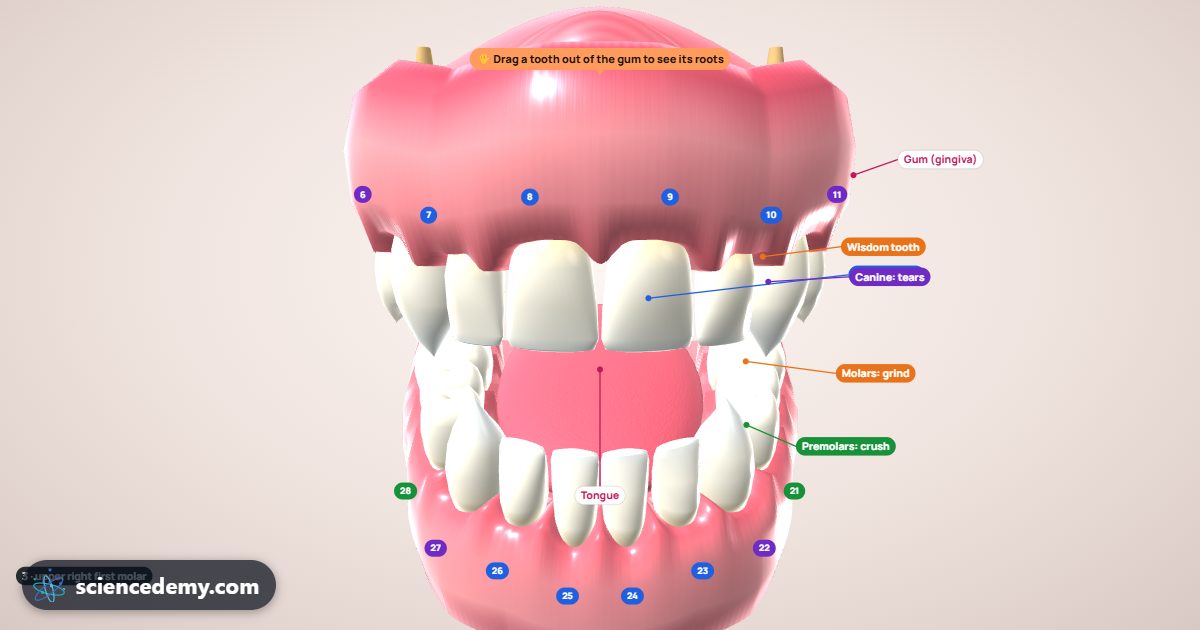
A teeth numbers chart (a teeth diagram with numbers, or tooth number diagram) gives every tooth its own number so dentists can record exactly which one they mean. In the Universal system used in the US, adult teeth are numbered 1 to 32, starting with the upper right wisdom tooth and finishing with the lower right wisdom tooth. Most of the world uses the FDI system, where each tooth has two digits: the first says which quarter of the mouth, the second its position from the middle.
All teeth diagram numbers you will see come from one of three systems: Universal, FDI or Palmer.
How does Universal tooth numbering work?
Universal tooth numbering runs in one continuous loop, as if you were looking into the patient's mouth:
- Start at the upper right third molar (wisdom tooth): that is tooth 1.
- Count along the upper jaw towards the patient's left: the upper right central incisor is 8 and the upper left central incisor is 9.
- The upper left wisdom tooth is 16.
- Drop to the lower jaw on the same side: the lower left wisdom tooth is 17.
- Count back along the lower jaw: the lower left central incisor is 24, the lower right central incisor is 25, and the lower right wisdom tooth is 32.
"Right" and "left" always mean the patient's right and left. On a dental chart the patient faces you, so their right side is on your left.
Worked example: which number is the upper left first molar?
In the upper left quarter the teeth go from the middle: central incisor (9), lateral incisor (10), canine (11), first premolar (12), second premolar (13), first molar (14). So the upper left first molar is tooth 14 in the Universal system.
How does FDI tooth numbering work?
FDI tooth numbering (also called ISO 3950, or the two-digit system) is used by dentists in the UK, Europe, Australia and most other countries. Every tooth gets two digits:
| First digit | Quarter (quadrant) |
|---|---|
| 1 | upper right |
| 2 | upper left |
| 3 | lower left |
| 4 | lower right |
The second digit counts from the middle of the mouth: 1 central incisor, 2 lateral incisor, 3 canine, 4 first premolar, 5 second premolar, 6 first molar, 7 second molar, 8 third molar (wisdom tooth).
So tooth 36 is the lower left first molar, and tooth 11 is the upper right central incisor. Say the digits separately: "three-six", not "thirty-six".
Universal and FDI side by side
| Tooth | Universal | FDI |
|---|---|---|
| Upper right wisdom tooth | 1 | 18 |
| Upper right first molar | 3 | 16 |
| Upper right central incisor | 8 | 11 |
| Upper left central incisor | 9 | 21 |
| Upper left canine | 11 | 23 |
| Lower left first molar | 19 | 36 |
| Lower right central incisor | 25 | 41 |
| Lower right wisdom tooth | 32 | 48 |
What is the Palmer notation?
The Palmer notation is an older system still used by some orthodontists in the UK. Each quarter has its teeth numbered 1 to 8 from the middle, and a right-angle symbol shows the quarter: the corner points towards the middle of the mouth. The upper right first molar is written 6┘ and the lower left canine is ┌3.
How are baby teeth numbered?
Children have 20 baby teeth (primary or deciduous teeth): in each quarter, two incisors, one canine and two molars. There are no premolars.
- Universal system: baby teeth use letters A to T in the same loop as adult teeth. A is the upper right second molar, J is the upper left second molar, K is the lower left second molar and T is the lower right second molar.
- FDI system: the quarters become 5, 6, 7 and 8 (upper right, upper left, lower left, lower right), and the second digit runs 1 to 5. Tooth 55 is the upper right second baby molar.
This makes a baby teeth chart easy to tell apart from an adult one at a glance.
What do the different types of teeth do?
Adults have 32 teeth: in each quarter, 2 incisors, 1 canine, 2 premolars and 3 molars.
- Incisors (8): thin, chisel-shaped front teeth that cut and bite.
- Canines (4): pointed teeth that grip and tear. They have the longest roots in the mouth.
- Premolars (8): two cusps each, for tearing and crushing.
- Molars (12, including 4 wisdom teeth): broad teeth with four or five cusps that grind food. Upper molars usually have three roots; lower molars have two.
The first adult molars come in at about 6 to 7 years old, behind the baby teeth, without any baby tooth falling out first. Wisdom teeth usually appear between 17 and 21, if they appear at all.
What is inside a tooth?
Every tooth has a crown above the gum and one or more roots in the jaw bone. The crown is covered in enamel, the hardest substance in the human body (about 96 % mineral). Underneath is dentine, which makes up most of the tooth. In the middle is the pulp, with the nerve and blood vessels, which enter through the tip of the root. The root is covered in cementum, which anchors it to the bone.
Common mistakes
- Mixing up right and left. The numbers use the patient's sides, not yours.
- Reading FDI numbers as one number. 36 means quarter 3, tooth 6, not "thirty-six".
- Forgetting that the Universal loop turns at the back. After 16 (upper left) comes 17 (lower left), not lower right.
- Expecting premolars in a child's mouth. Baby teeth have molars but no premolars; the adult premolars replace the baby molars.
Frequently asked questions
What number is a wisdom tooth?
In the Universal system the four wisdom teeth are 1, 16, 17 and 32: upper right, upper left, lower left and lower right. In the FDI system they are 18, 28, 38 and 48, because the third molar is always position 8 in its quarter. Many adults are missing one or more wisdom teeth, but the other teeth keep their numbers.
Which tooth is number 14?
In the Universal system, tooth 14 is the upper left first molar, the large grinding tooth behind the two premolars on the patient's upper left. In the FDI system, 14 means something different: quarter 1 (upper right), position 4, which is the upper right first premolar. Always check which system a chart is using.
Why do dentists in different countries use different numbers?
The Universal system was adopted by the American Dental Association, while the FDI two-digit system was adopted by the FDI World Dental Federation and the International Organization for Standardization (ISO 3950). Most countries outside the US use FDI because it is quicker to say and works the same way for baby teeth.
How many teeth do humans have?
Adults have 32 teeth including the four wisdom teeth, or 28 without them. Children have 20 baby teeth, which start coming in at about 6 months and are replaced by adult teeth from about age 6 to 12.
Try it yourself
Open the interactive teeth diagram and click any tooth to see its Universal, FDI and Palmer numbers, its job and its roots. Switch between Adult (32) and Baby (20), then choose Inside a tooth to cut one open in 3D and drag the decay slider to see a cavity reach the pulp. Turn up the sugary snacks and brush the plaque off with the toothbrush to see why molars decay first. For more on what keeps the body's tissues alive, read how blood works.
شاهد بنفسك، وبأبعاد ثلاثية ومجانيًا.
جرّبها على Teeth & Tooth Numbers