Virtual Chemistry Lab: Free Online Experiments
A free virtual chemistry lab you can use in your browser: mix chemicals, heat them, test the gases and read the balanced equation for every reaction, in 3D.
Open the virtual chemistry lab
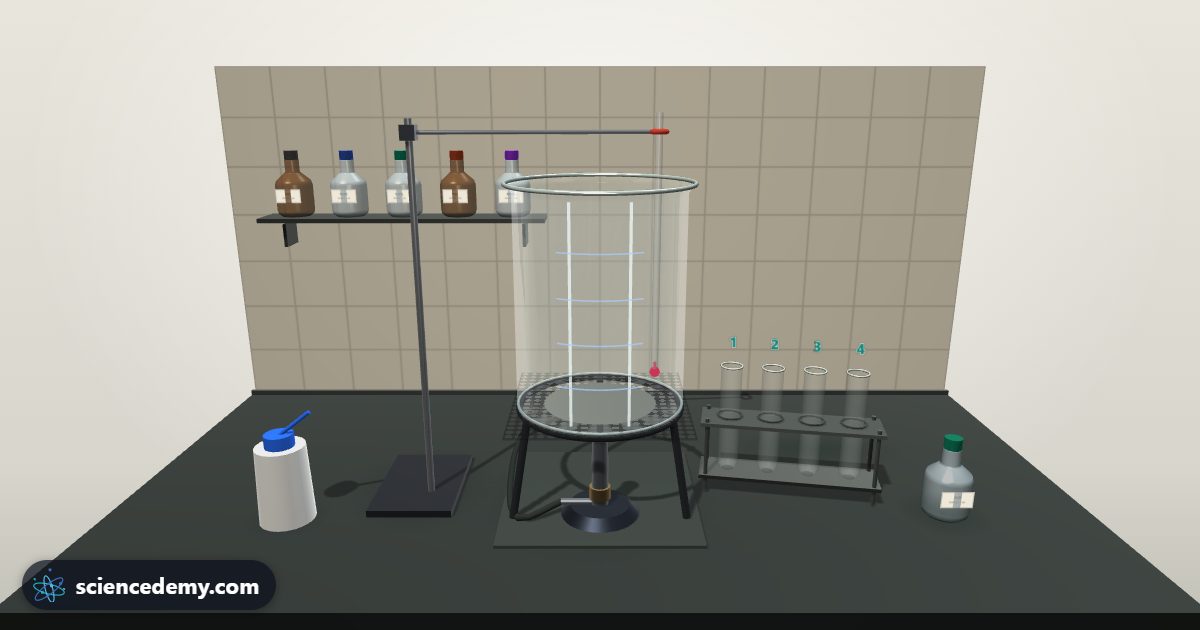
What is a virtual chemistry lab?
A virtual chemistry lab is a chemistry practical you run on a screen. Instead of watching a video, you choose the chemicals, the glassware and the temperature yourself, and the lab shows what really happens: colour changes, bubbles, precipitates, flames and fumes. Because it is a simulation, every experiment is safe, free and repeatable, and you can turn the bench round in 3D to look from any angle.
The Science Academy lab does not play pre-recorded clips. It works out each reaction from the chemistry rules you learn at school (the reactivity series, solubility rules, acids and bases), so it also handles mixtures nobody planned for. Every result comes with the product names and a balanced equation.
10 experiments ready to run
Each one sets up the glassware and adds the chemicals step by step, so you can watch and then try it yourself.
| Experiment | What you see | Equation |
|---|---|---|
| بركان بيكربونات الصوديوم | Vinegar on baking soda foams up as carbon dioxide escapes. | NaHCO₃ + CH₃COOH → CH₃COONa + H₂O + CO₂ |
| المطر الذهبي | Two clear solutions make a bright yellow precipitate of lead iodide. | 2KI + Pb(NO₃)₂ → PbI₂ + 2KNO₃ |
| معجون الفيل | Manganese dioxide catalyses hydrogen peroxide into a tower of oxygen foam. | 2H₂O₂ → 2H₂O + O₂ (MnO₂ catalyst) |
| Silver tree | Copper is more reactive than silver, so silver crystals grow and the solution turns blue. | Cu + 2AgNO₃ → Cu(NO₃)₂ + 2Ag |
| اختبار ماء الجير | Carbon dioxide turns limewater milky with a calcium carbonate precipitate. | Ca(OH)₂ + CO₂ → CaCO₃ + H₂O |
| قوس قزح المؤشر | Universal indicator goes red in acid, green at pH 7 and purple in alkali as you add sodium hydroxide. | HCl + NaOH → NaCl + H₂O |
| إزاحة الهالوجين | Chlorine pushes bromine out of potassium bromide, turning the solution orange-brown. | Cl₂ + 2KBr → 2KCl + Br₂ |
| Potassium in water | An alkali metal fizzes across the surface with a lilac flame and leaves an alkaline solution. | 2K + 2H₂O → 2KOH + H₂ |
| كبريتات النحاس الزرقاء | Black copper oxide dissolves in warm sulfuric acid to make a blue salt solution. | CuO + H₂SO₄ → CuSO₄ + H₂O |
| المغنيسيوم المحترق | Magnesium burns with a dazzling white flame and leaves white magnesium oxide. | 2Mg + O₂ → 2MgO |
Types of reaction you can explore
- Neutralisation: acid + alkali → salt + water, with universal indicator showing the pH change.
- Acids with metals and carbonates: hydrogen or carbon dioxide fizzes off, ready to test.
- Precipitation: two solutions make an insoluble solid, decided by the solubility rules.
- Displacement: a more reactive metal or halogen pushes a less reactive one out of its compound.
- Metals with water: from a slow fizz to the violent alkali metals.
- Combustion and decomposition: burning elements in oxygen and breaking compounds down with heat.
- Catalysts and coloured complexes: elephant toothpaste, the royal-blue copper–ammonia complex, starch–iodine.
Tests for gases
When a reaction gives off a gas, test it the way you would in a real lab:
| غاز | Test and result |
|---|---|
| Hydrogen (H₂) | A lit splint gives a squeaky pop. |
| Oxygen (O₂) | A glowing splint relights. |
| Carbon dioxide (CO₂) | Limewater turns milky. |
| Ammonia (NH₃) | Damp red litmus turns blue. |
| Sulfur dioxide (SO₂) | Acidified potassium dichromate paper turns from orange to green. |
| Chlorine (Cl₂) | Damp blue litmus turns red, then bleaches white. |
How to use the virtual chemistry lab
- Choose your glassware: beaker, test tube, conical flask or round-bottom flask.
- Drag chemicals from the shelf into it.
- Light the Bunsen burner if the reaction needs heat, and watch the thermometer.
- Add universal indicator to read the pH from the colour.
- Test any gas that bubbles off, then read the products and the balanced equation.
For GCSE and IGCSE chemistry
The lab covers the chemistry behind several required practicals: making a soluble salt from an insoluble base (copper oxide and sulfuric acid), the tests for gases, precipitate tests, neutralisation with an indicator, and the reactivity series. Run the virtual version first to predict what will happen, then compare it with your real results. To practise the equations themselves, use the equation balancer; to see why the ions behave as they do, try ions and ionic bonding تم تصميم [الخدمة] لمتعلمين من جميع الأعمار، بما في ذلك طلاب المدارس. electrolysis.
Looking for physics and biology too? The virtual 3D science lab lists every lab on the site, and the كيمياء page has all the chemistry tools.
الأسئلة الشائعة
Is there a free virtual chemistry lab?
Yes. The Science Academy virtual chemistry lab is free, with no login, no download and no adverts in the lab. It runs in the browser on laptops, Chromebooks, tablets and phones.
What can you do in a virtual chemistry lab?
Pick chemicals from a shelf, pour them into a beaker, test tube, conical or round-bottom flask, heat them on a Bunsen burner, add universal indicator and test any gas given off. The lab shows the products, the balanced equation and what you would see.
Are the reactions real or scripted?
Most reactions are worked out from real chemistry rules: the reactivity series, solubility rules, acids and bases. So you can mix pairs nobody planned for and still get the right products and equation. A few special reactions, such as catalysts and coloured complexes, are added by hand.
Can a virtual chemistry lab replace school practicals?
Not fully: handling real glassware matters. Use it before a practical to plan and predict, after it to explain your results, and for reactions too dangerous for a classroom, such as potassium in water or making chlorine.
Which exams does it help with?
The chemistry in it matches KS3, GCSE, IGCSE and the early part of A level: reactions of acids, making salts, the reactivity series, precipitation, halogens, alkali metals, catalysts and tests for gases.
Is it safe for students to use?
Completely. Nothing can spill, burn or explode, so students can try the dangerous experiments too, and see why they are dangerous.
