Conservation of Energy Examples (10 Everyday Ones)
Ten conservation of energy examples from everyday life, from a swinging pendulum to car brakes, showing where the energy goes each time and why the total never changes.
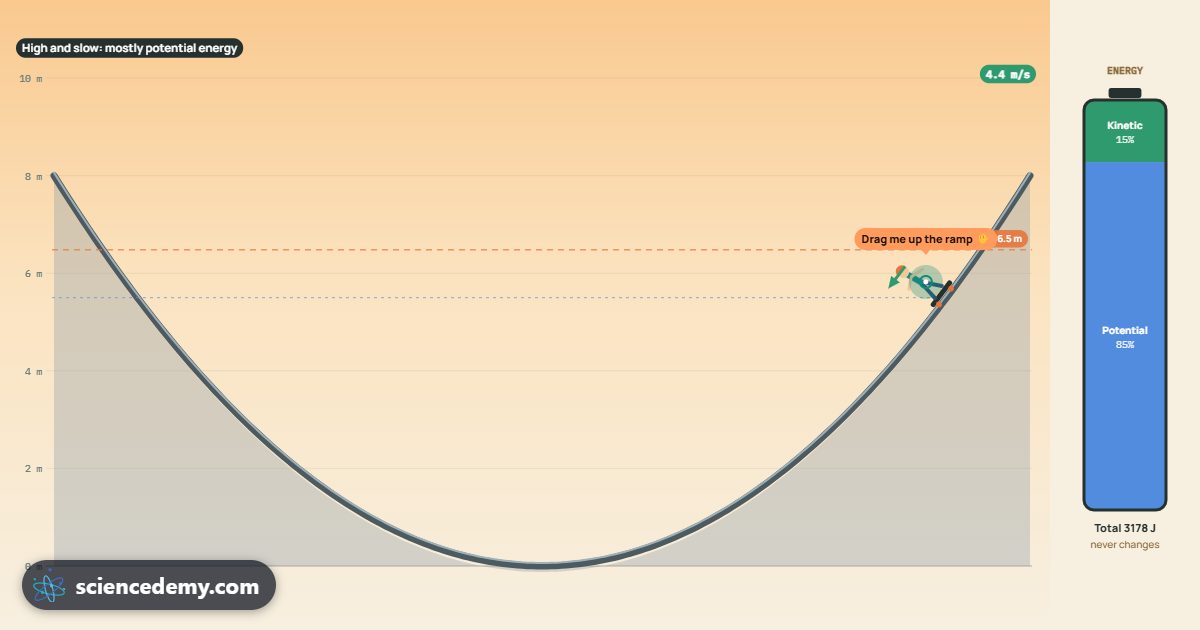
Good conservation of energy examples are all around you: a swinging pendulum, a ball bouncing, a car braking, a torch shining. In every one, energy changes from one store to another, but the total amount stays exactly the same. That is the law of conservation of energy: energy cannot be created or destroyed, only transferred or transformed. The trick to every example below is to follow the energy and ask where it ends up.
What is the law of conservation of energy?
The law says that in a closed system the total energy before something happens equals the total energy after it. Energy can sit in different stores: kinetic (movement), gravitational potential (height), elastic (stretch or squash), chemical (fuels, food, batteries), thermal (heat) and nuclear. It moves between them by forces, electric currents, heating and waves (light and sound).
So when energy seems to "disappear", it has always gone somewhere else, usually into heating the surroundings, which is hard to see and hard to get back.
10 conservation of energy examples in everyday life
These conservation of energy examples in everyday life go from simple to surprising.
1. A swinging pendulum
At the top of its swing, a pendulum is momentarily still: all its energy is gravitational potential. As it falls, that changes into kinetic energy, so it moves fastest at the bottom. Then kinetic turns back into potential as it climbs the other side. You can time this yourself in the Pendulum Lab.
2. A skateboarder in a half-pipe
The same swap happens on a skate ramp: high and slow at the top, low and fast at the bottom. Without friction the skater would reach the same height on both sides forever. In reality each swing is a little lower, because some energy heats the wheels and the ramp.
3. Dropping a ball
Drop a 1 kg ball from 5 m. Its potential energy at the top is mgh = 1 × 9.8 × 5 = 49 J. Just before it lands, that has all become kinetic energy (ignoring air resistance), so it hits the ground at about 9.9 m/s. This is the clearest case of potential energy to kinetic energy: none is gained, none is lost.
4. A bouncing ball
Each bounce is lower than the last. On impact the ball squashes, storing elastic energy that pushes it back up, but some energy goes into sound (the bounce you hear) and heat in the ball and floor. Add those up and the total still matches.
5. A car braking
A moving car has lots of kinetic energy. When it brakes, friction between the brake pads and discs turns that kinetic energy into thermal energy: brakes can get hot enough to glow after a hard stop down a mountain. Electric cars use regenerative braking, turning some of that kinetic energy back into chemical energy in the battery instead.
6. A torch (flashlight)
Chemical energy in the battery becomes electrical energy in the circuit, then light and heat in the bulb. An LED turns far more of it into light than an old filament bulb, which wasted most of its energy as heat. "Efficient" doesn't mean energy is saved from nowhere: it means less of it ends up as heat you didn't want.
7. A hydroelectric dam
Water held high behind a dam stores gravitational potential energy. As it falls through pipes it speeds up (kinetic), spins turbines, and generators turn that movement into electrical energy for the grid.
8. Eating and running
Food stores chemical energy. Your muscles transfer it into kinetic energy when you run, and a large share becomes thermal energy, which is why you get hot when you exercise.
9. A bow and arrow
Pulling the string back stores elastic potential energy in the bent bow. Let go and that energy becomes the arrow's kinetic energy. Shoot it upwards and kinetic turns into gravitational potential until it stops, then back into kinetic on the way down.
10. The Sun and a plant
Nuclear fusion in the Sun turns a little mass into energy (see how nuclear fusion works), which reaches Earth as light. Plants store that light as chemical energy in sugar through photosynthesis, and the food chain passes it on. Almost every example above started as sunlight.
Is energy ever lost?
No. Is energy ever lost is the most common question about this law, and the answer is always no: it is only spread out. When people say a machine "loses" energy, they mean energy was transferred somewhere useless, usually as heat warming the air or sound. This is why no machine is 100% efficient and why a perpetual motion machine is impossible: friction and air resistance always move some energy into the surroundings, where it can't be collected again.
Energy in a collision behaves the same way. In conservation of momentum, momentum is conserved in every crash, while kinetic energy may not stay as kinetic energy: in a sticky collision some of it becomes heat and sound, but the total energy is still conserved.
Common mistakes
- Saying energy is "used up". It is transferred, not destroyed. A flat battery's energy is now heat and light in the room.
- Forgetting the wasted stores. Heat and sound are part of the total, even if they're not useful.
- Mixing up energy and power. Power is how fast energy is transferred (joules per second), not an amount of energy.
- Thinking the pendulum stops because energy vanishes. It slows because air resistance and friction at the pivot keep moving energy into the air as heat.
Frequently asked questions
What is a simple example of conservation of energy?
A swinging pendulum is the simplest example. At the top of each swing all its energy is gravitational potential; at the bottom it is all kinetic. It keeps swapping between the two, and the total stays the same until air resistance slowly transfers it to the surrounding air as heat, which is why the swings gradually get smaller.
Who discovered the law of conservation of energy?
Several scientists reached it in the 1840s. Julius Robert von Mayer and James Prescott Joule both showed that work and heat are forms of the same thing, Joule by measuring how much falling weights warmed water as they turned a paddle. Hermann von Helmholtz then stated the law in general form in 1847. The joule, the unit of energy, is named after Joule.
Does conservation of energy apply to the whole universe?
As far as we know, yes, for any closed system, and the universe is the biggest closed system there is. Einstein's E = mc² extended the law: mass is a form of energy too, so in nuclear reactions a little mass turns into energy, and the total of mass-energy is what stays constant.
What is the formula for conservation of energy?
For an object moving up and down with no friction: mgh + ½mv² stays constant, where m is mass, g is gravitational field strength (9.8 N/kg), h is height and v is speed. So the potential energy lost while falling equals the kinetic energy gained. With friction, add the energy transferred as heat to the total.
Try it yourself
Open the Energy Skate Park and drop a skater into the half-pipe: watch the kinetic, potential and thermal energy bars swap in real time while the total stays the same. Turn friction on and see the thermal bar grow as each swing gets lower.
شاهد بنفسك، وبأبعاد ثلاثية ومجانيًا.
جرّبها على منتزه تزلج الطاقة