How Blood Works: What It Is Made Of and What It Does
How blood works: plasma, red and white blood cells and platelets, how it carries oxygen, fights infection and clots, and how the heart pumps it round two circuits.
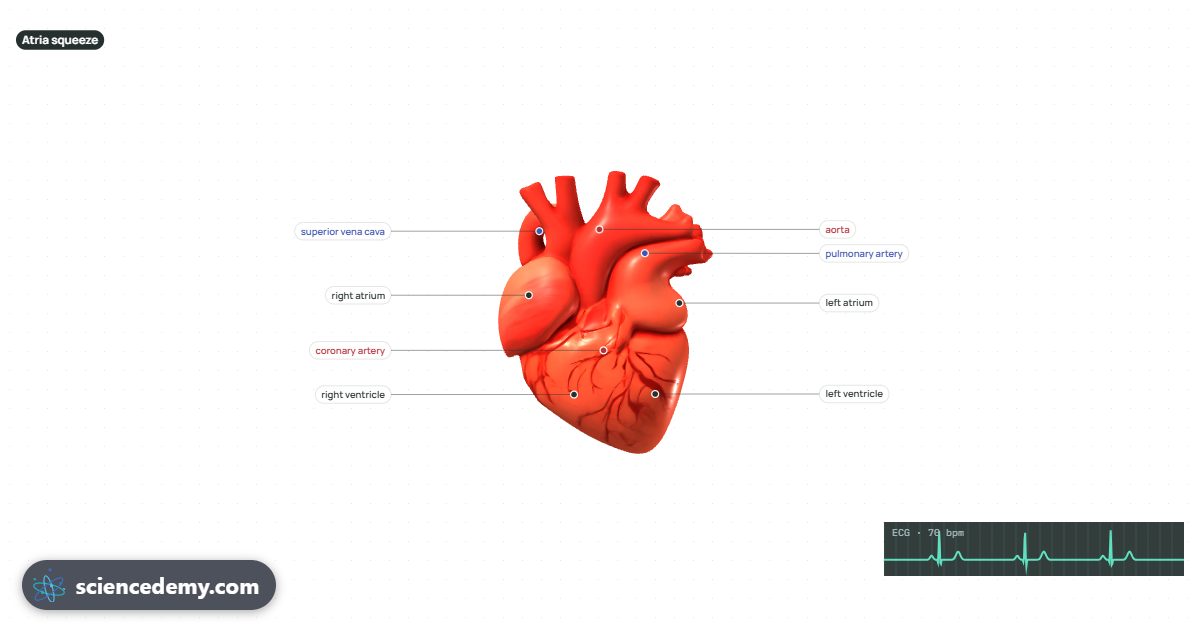
How blood works in short: blood is a liquid tissue that the heart pumps round your body about once a minute. Its liquid part, plasma, carries food, carbon dioxide, hormones and heat; its red blood cells carry oxygen; its white blood cells fight infection; and its platelets seal cuts through blood clotting. An adult has about 5 litres of it, roughly 7% of body mass.
What is blood made of?
Blood is about 55% plasma and 45% cells. Spin a sample in a centrifuge and it separates into layers: straw-coloured plasma on top, a thin pale layer of white cells and platelets, and dark red cells at the bottom.
| Part | Share of blood | What it does |
|---|---|---|
| Plasma | about 55% | Water (90%) carrying glucose, amino acids, CO₂, urea, hormones, antibodies and heat |
| Red blood cells | about 44% | Carry oxygen from the lungs to every cell |
| White blood cells | under 1% | Destroy pathogens and make antibodies |
| Platelets | under 1% | Cell fragments that help blood clot |
What do red blood cells do?
Red blood cells carry oxygen. Each one is packed with about 270 million molecules of haemoglobin, a red protein containing iron. In the lungs, where oxygen is plentiful, haemoglobin picks oxygen up and becomes oxyhaemoglobin (bright red). In the tissues, where oxygen is scarce, it lets the oxygen go.
Red blood cells are adapted for the job:
- Biconcave disc shape: a flattened disc with a dip on both sides gives a large surface area for oxygen to diffuse in and out.
- No nucleus: more room for haemoglobin.
- Small and flexible: about 7 µm across, so they can squeeze through capillaries only one cell wide.
You make about 2 million red blood cells every second in your bone marrow, and each lasts about 120 days before the liver and spleen break it down.
How does blood fight infection?
White blood cells defend the body against pathogens (bacteria, viruses and fungi) in two main ways:
- Phagocytes engulf pathogens and digest them (phagocytosis).
- Lymphocytes make antibodies, proteins that stick to one particular pathogen and mark it for destruction. Some also make antitoxins that neutralise poisons.
After an infection, memory lymphocytes stay in the blood, so the same pathogen is destroyed faster next time. That is how vaccines work: they teach the lymphocytes without making you ill.
How does blood clot?
When a blood vessel is cut, platelets stick to the damaged wall and release chemicals that start a chain of reactions. The soluble plasma protein fibrinogen is turned into insoluble fibrin threads, which form a mesh. Red blood cells get trapped in the mesh, making a clot that seals the wound and later dries into a scab. Clotting stops blood loss and keeps pathogens out, but a clot inside a vessel (a thrombosis) can block blood flow to the heart or brain.
How does blood travel round the body?
Blood travels round the body in a double circulatory system: it passes through the heart twice on every complete journey.
- Pulmonary circuit: the right side of the heart pumps deoxygenated blood to the lungs, where it picks up oxygen and loses carbon dioxide, then returns to the left side of the heart.
- Systemic circuit: the left side of the heart pumps oxygenated blood to the rest of the body, then it returns, deoxygenated, to the right side.
The left ventricle's wall is about three times thicker than the right's, because it has to push blood all the way round the body at high pressure. Two circuits keep the pressure high where it is needed, which is why mammals and birds can be so active.
Arteries, veins and capillaries
| Vessel | Carries blood | Built for |
|---|---|---|
| Arteries | Away from the heart, at high pressure | Thick muscular, elastic walls |
| Capillaries | Through the tissues | Walls one cell thick, so substances diffuse in and out |
| Veins | Back to the heart, at low pressure | Thin walls, wide space and valves to stop backflow |
Worked example: cardiac output
Cardiac output is the volume of blood the heart pumps per minute:
cardiac output = stroke volume × heart rate
At rest, with a stroke volume of 70 ml and a heart rate of 70 beats per minute:
cardiac output = 70 × 70 = 4900 ml/min ≈ 4.9 litres per minute
That is nearly all your blood, every minute. During hard exercise, stroke volume and heart rate both rise, and cardiac output can reach 20 to 25 litres per minute.
Common mistakes
- Saying deoxygenated blood is blue. It is dark red. Veins only look blue through the skin because of how light scatters.
- Saying arteries carry oxygenated blood. Arteries carry blood away from the heart; the pulmonary artery carries deoxygenated blood to the lungs.
- Mixing up platelets and white blood cells. Platelets clot; white cells fight infection.
- Forgetting plasma's jobs. Plasma, not the red cells, carries most of the carbon dioxide (as hydrogencarbonate ions), plus glucose, urea and hormones.
Frequently asked questions
How long does it take blood to go round the body?
At rest, blood takes about a minute to go all the way round the body and back to the heart. The heart pumps around 5 litres per minute and you have about 5 litres of blood. During exercise the heart pumps four or five times faster, so a complete circuit can take as little as 10 to 15 seconds.
Why is blood red?
Blood is red because of haemoglobin, the iron-containing protein in red blood cells. When haemoglobin carries oxygen it is bright scarlet; without oxygen it is darker, a deep maroon. It is never actually blue: veins look bluish because skin absorbs red light from deeper vessels and reflects more blue.
What are blood groups?
Blood groups (A, B, AB and O) depend on markers called antigens on the surface of red blood cells. Your plasma contains antibodies against the antigens you don't have, so a transfusion of the wrong group makes the red cells clump together. Group O negative has no A, B or Rhesus antigens, so it can be given to almost anyone in an emergency.
Where is blood made?
Blood cells are made in the bone marrow, the soft tissue inside large bones such as the hips, ribs, breastbone and spine. Stem cells there divide to make red blood cells, white blood cells and platelets. An adult makes about 2 million red blood cells every second to replace those that wear out.
Try it yourself
Open the Heart & Circulation lab and switch on Follow one blood cell: watch it pass through the right atrium, the lungs and the left ventricle, turning from blue to red as it picks up oxygen. Then press Running and see how heart rate, stroke volume and cardiac output change. To see what happens to a red blood cell in the wrong solution, read red blood cells in salt water, and to see how nerves control the heartbeat, read how a neuron works.
See it for yourself, in 3D and free.
Try it in the Heart & Circulation