How to Balance Chemical Equations: Step-by-Step Guide
To balance a chemical equation, change only the big numbers in front until each element has the same atoms on both sides. Steps, worked examples and an animation.
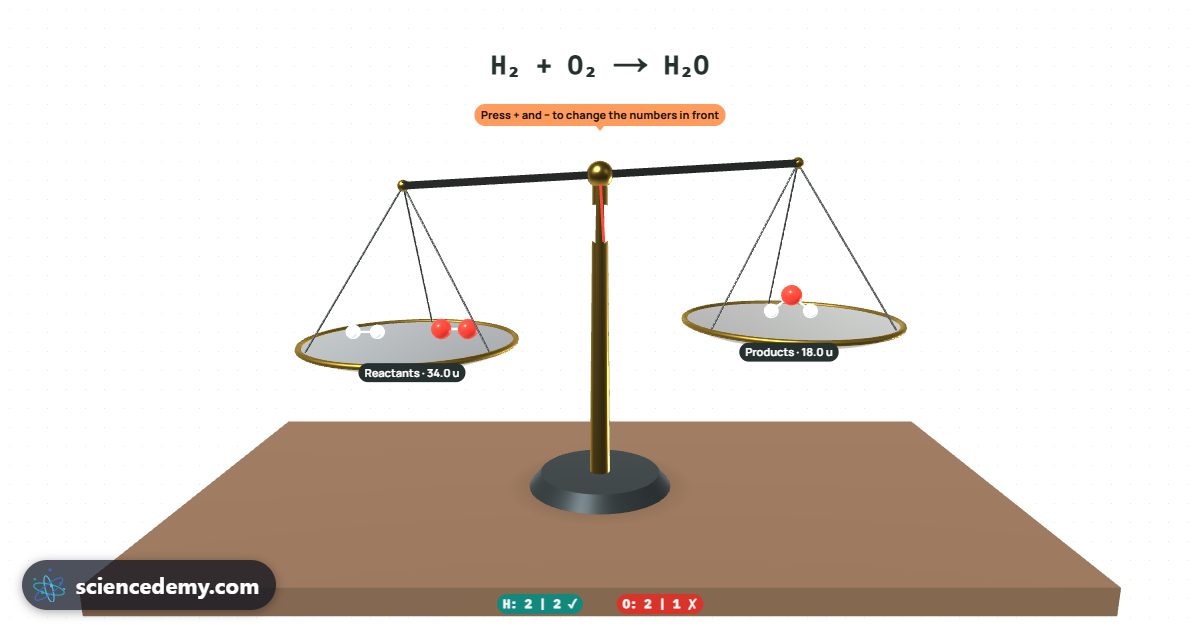
To learn how to balance chemical equations, remember one rule: atoms are never created or destroyed in a reaction, so every element must have the same number of atoms on both sides of the arrow. You balance an equation by changing only the coefficients, the big numbers in front of each formula, never the small numbers inside it. For example, H₂ + O₂ → H₂O becomes 2H₂ + O₂ → 2H₂O: 4 hydrogen atoms and 2 oxygen atoms on each side.
Why do chemical equations need to be balanced?
A chemical equation must be balanced because of the law of conservation of mass: the total mass of the products equals the total mass of the reactants. Antoine Lavoisier showed this in 1789 by weighing reactions in sealed containers. In a reaction the atoms only swap partners. None appear and none vanish.
An unbalanced equation such as H₂ + O₂ → H₂O says that two oxygen atoms went in and only one came out. That cannot happen. A balanced chemical equation shows the real ratio in which substances react, which is what you need for any calculation of masses, moles or gas volumes.
What are coefficients and subscripts?
These two kinds of number do different jobs, and mixing them up causes most mistakes.
| Number | Example | What it means | Can you change it? |
|---|---|---|---|
| Subscript (small, after a symbol) | the 2 in H₂O | 2 H atoms in each molecule | No: it would make a different substance |
| Coefficient (big, in front) | the 3 in 3H₂O | 3 whole molecules of water | Yes: this is how you balance |
Changing H₂O to H₂O₂ would "balance" the oxygen, but H₂O₂ is hydrogen peroxide, a bleach, not water. The coefficients in chemical equations tell you how many molecules (or moles) take part. The subscripts are fixed by the formula.
To count atoms, multiply the coefficient by the subscript. In 3H₂O there are 3 × 2 = 6 hydrogen atoms and 3 × 1 = 3 oxygen atoms.
How do you balance a chemical equation step by step?
This method works for every equation you meet at GCSE and most at A level. Here is balancing chemical equations step by step:
- Write the correct formulas for every reactant and product. Don't change them again.
- Count the atoms of each element on both sides. A table helps.
- Pick an element that is unbalanced and appears in only one substance on each side. Change one coefficient to fix it.
- Recount everything, because fixing one element can unbalance another.
- Leave elements that stand alone (O₂, H₂, Cl₂, Fe) until last. They are the easiest to adjust because changing them affects only one element.
- Check that every element matches, and that the coefficients are in their lowest whole-number ratio.
Worked example 1: making water
Start with H₂ + O₂ → H₂O.
- Left: 2 H, 2 O. Right: 2 H, 1 O. Oxygen is off.
- Put a 2 in front of the water: H₂ + O₂ → 2H₂O. Right is now 4 H, 2 O.
- Hydrogen is off now (2 on the left, 4 on the right). Put a 2 in front of H₂: 2H₂ + O₂ → 2H₂O.
- Left: 4 H, 2 O. Right: 4 H, 2 O. Balanced.
Worked example 2: burning methane
CH₄ + O₂ → CO₂ + H₂O
| Element | Left | Right |
|---|---|---|
| C | 1 | 1 |
| H | 4 | 2 |
| O | 2 | 3 |
Carbon is fine. Hydrogen: 4 on the left, so make it 2H₂O (4 H). Now count oxygen on the right: 2 in CO₂ plus 2 in 2H₂O = 4. Oxygen stands alone on the left, so make it 2O₂:
CH₄ + 2O₂ → CO₂ + 2H₂O
Worked example 3: rusting iron
Fe + O₂ → Fe₂O₃ is harder because oxygen comes in pairs on the left and threes on the right. The lowest number that both 2 and 3 go into is 6, so aim for 6 oxygen atoms: 3O₂ and 2Fe₂O₃. That gives 4 Fe on the right, so put 4Fe on the left:
4Fe + 3O₂ → 2Fe₂O₃
Check: 4 Fe and 6 O on each side.
More balanced chemical equation examples
| Reaction | Balanced equation |
|---|---|
| Sodium + chlorine | 2Na + Cl₂ → 2NaCl |
| Haber process (ammonia) | N₂ + 3H₂ → 2NH₃ |
| Magnesium + hydrochloric acid | Mg + 2HCl → MgCl₂ + H₂ |
| Burning aluminium | 4Al + 3O₂ → 2Al₂O₃ |
| Burning propane | C₃H₈ + 5O₂ → 3CO₂ + 4H₂O |
| Neutralisation | NaOH + HCl → NaCl + H₂O |
For hydrocarbons that burn completely, balance carbon first (it all goes to CO₂), then hydrogen (it all goes to H₂O), and oxygen last.
What do state symbols mean?
A full balanced equation often adds state symbols in brackets: (s) solid, (l) liquid, (g) gas and (aq) aqueous, meaning dissolved in water. For example, Mg(s) + 2HCl(aq) → MgCl₂(aq) + H₂(g). State symbols don't change the balancing, but exam questions often ask for them.
Common mistakes
- Changing subscripts. Writing H₂O₂ or O to make the numbers fit changes the chemistry. Only touch the coefficients.
- Forgetting to multiply. 2Fe₂O₃ contains 4 Fe and 6 O, not 2 and 3.
- Not recounting. Fixing hydrogen in methane changes the oxygen count. Recount every element after each change.
- Leaving fractions or non-lowest ratios. 4H₂ + 2O₂ → 4H₂O has the same number of atoms on both sides, but the answer expected is 2H₂ + O₂ → 2H₂O. If you used ½O₂ along the way, double everything at the end.
- Writing "1". A coefficient of 1 is left out: write O₂, not 1O₂.
Frequently asked questions
What is the easiest way to balance chemical equations?
Count the atoms of each element on both sides in a small table. Fix one element at a time by changing a coefficient, starting with elements found in compounds, and leave lone elements such as O₂ or H₂ until last. Recount after every change. When every row of your table matches, check that the coefficients can't be divided by a common number, and you are done.
Why can't you change the subscripts when balancing?
Subscripts are part of a substance's formula, so changing one changes what the substance is. H₂O is water, but H₂O₂ is hydrogen peroxide, and CO is a poisonous gas rather than carbon dioxide (CO₂). Balancing has to describe the real reaction, so the formulas stay fixed and only the number of molecules, the coefficient, can change.
Does a balanced equation mean mass is conserved?
Yes. A balanced equation has exactly the same atoms on both sides, and atoms keep their mass, so the total mass of the reactants equals the total mass of the products. If mass seems to change in an experiment, a gas has usually escaped or been absorbed from the air, for example the CO₂ given off when a metal carbonate reacts with acid.
What does the coefficient in a chemical equation tell you?
A coefficient tells you how many molecules, formula units or atoms of a substance take part. It also gives the ratio in moles. In 2H₂ + O₂ → 2H₂O, 2 moles of hydrogen react with 1 mole of oxygen to make 2 moles of water. That ratio is the starting point for every reacting-mass calculation.
Try it yourself
Open the Molecule Builder and press ⚖️ Simulation: balancing equations in the Learn panel. Pick a reaction, use + and − to change the coefficients, and watch the atom counts for each element turn green. Once both sides match, the molecules break apart and their atoms fly across to build the products, so you can see that nothing is lost. Start with Making water, then try Rusting iron and Burning propane. To see real reactions with balanced equations worked out for you, mix chemicals in the Chemistry Lab, and read ionic vs covalent bonds to see why the formulas are what they are.
See it for yourself, in 3D and free.
Try it in the Equation Balancer