Unit Circle Explained: Sin, Cos, Tan and Radians
The unit circle explained: why the point at angle θ is (cos θ, sin θ), the exact values chart for every key angle, radians, the CAST rule, and an interactive unit circle.
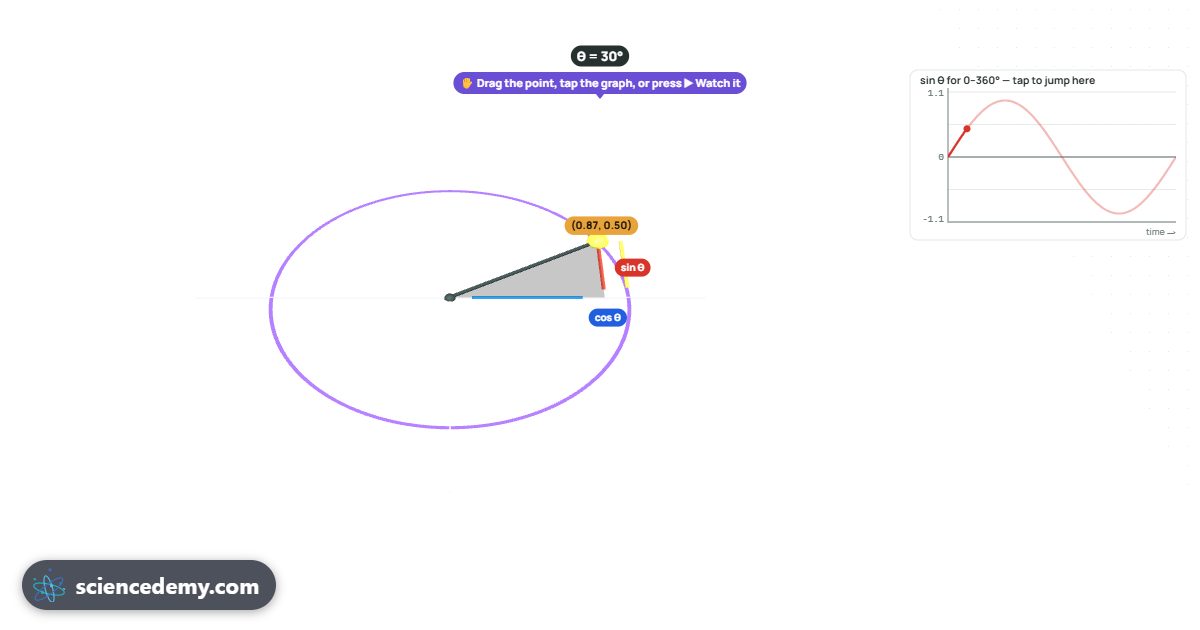
The unit circle is a circle with a radius of exactly 1, centred at the origin (0, 0). For any angle θ, measured anticlockwise from the positive x-axis, the point where the angle's line meets the circle is (cos θ, sin θ). So the x-coordinate is the cosine of the angle and the y-coordinate is the sine. That is the unit circle explained in one line, and this one idea defines sin, cos and tan for every angle, not just the ones inside a right-angled triangle. You can drag the angle yourself on the interactive unit circle.
Why is the point (cos θ, sin θ)?
Drop a line from the point on the circle straight down to the x-axis and you get a right-angled triangle. Its hypotenuse is the radius, which is 1. Using SOH CAH TOA:
- sin θ = opposite ÷ hypotenuse = opposite ÷ 1 = the height (the y-coordinate)
- cos θ = adjacent ÷ hypotenuse = adjacent ÷ 1 = the width (the x-coordinate)
Because the hypotenuse is 1, the division disappears, and the sides of the triangle are the sine and cosine. That is the whole reason for choosing a radius of 1.
Applying Pythagoras' theorem to the same triangle gives the most important identity in trigonometry:
sin²θ + cos²θ = 1
What is tan on the unit circle?
tan θ = sin θ ÷ cos θ, the y-coordinate divided by the x-coordinate. That is the gradient of the radius line. On the diagram, tan θ is the height where the radius line, extended, crosses the vertical line x = 1.
At 90° and 270°, cos θ = 0, so tan θ = sin θ ÷ 0, which is undefined. The radius line is vertical and never meets x = 1.
What are radians?
A radian is the angle you get when the arc along the circle is the same length as the radius. Since the whole circumference is 2πr, a full turn is 2π radians = 360°, so:
- 180° = π radians
- radians = degrees × π ÷ 180
- degrees = radians × 180 ÷ π
One radian is about 57.3°. On the unit circle in radians, the angle and the arc length are the same number, because the radius is 1. That is why radians are the natural unit in calculus and physics.
Unit circle values chart
These exact values come from two special triangles: the 45-45-90 triangle (sides 1, 1, √2) and the 30-60-90 triangle (sides 1, √3, 2), each scaled so the hypotenuse is 1.
| Degrees | Radians | sin θ | cos θ | tan θ |
|---|---|---|---|---|
| 0° | 0 | 0 | 1 | 0 |
| 30° | π/6 | 1/2 | √3/2 | 1/√3 |
| 45° | π/4 | √2/2 | √2/2 | 1 |
| 60° | π/3 | √3/2 | 1/2 | √3 |
| 90° | π/2 | 1 | 0 | undefined |
| 120° | 2π/3 | √3/2 | −1/2 | −√3 |
| 135° | 3π/4 | √2/2 | −√2/2 | −1 |
| 150° | 5π/6 | 1/2 | −√3/2 | −1/√3 |
| 180° | π | 0 | −1 | 0 |
| 270° | 3π/2 | −1 | 0 | undefined |
| 360° | 2π | 0 | 1 | 0 |
As decimals, √2/2 ≈ 0.707 and √3/2 ≈ 0.866.
A trick for the first quadrant
For sin at 0°, 30°, 45°, 60°, 90°, write √0/2, √1/2, √2/2, √3/2, √4/2. That gives 0, 1/2, √2/2, √3/2, 1. Cos is the same list backwards.
How do you find sin, cos and tan on the unit circle for any angle?
To find sin cos tan on the unit circle for an angle bigger than 90°, use a reference angle and the sign of each quadrant:
- Find the quadrant. 0–90° is the first, 90–180° the second, 180–270° the third, 270–360° the fourth.
- Find the reference angle: the acute angle to the nearest part of the x-axis. For 150° it is 180° − 150° = 30°.
- Use the first-quadrant value for the reference angle.
- Fix the sign with the CAST rule, going anticlockwise from the fourth quadrant: Cos positive (4th), All positive (1st), Sin positive (2nd), Tan positive (3rd).
Worked example: 150°
150° is in the second quadrant, with a reference angle of 30°. Only sin is positive there.
- sin 150° = +sin 30° = 1/2
- cos 150° = −cos 30° = −√3/2 ≈ −0.866
- tan 150° = −tan 30° = −1/√3 ≈ −0.577
Check: (1/2)² + (√3/2)² = 1/4 + 3/4 = 1. ✓
Worked example: 240°
240° is in the third quadrant, reference angle 240° − 180° = 60°. Only tan is positive.
- sin 240° = −√3/2, cos 240° = −1/2, tan 240° = +√3.
How does the unit circle make a sine wave?
Move the point steadily around the circle and plot its height (sin θ) against the angle. The height rises from 0 to 1 at 90°, falls back to 0 at 180°, down to −1 at 270°, and returns to 0 at 360°. That graph is the sine wave, and it repeats every 360° (2π), its period. Plotting the x-coordinate instead gives the cosine wave, the same shape shifted by 90°.
This is why circular motion and oscillations are linked. A mass bouncing on a spring follows exactly this curve: see simple harmonic motion explained. Sound and light waves are described the same way in Waves & Sound.
Common mistakes
- Measuring the angle clockwise. Positive angles go anticlockwise from the positive x-axis; negative angles go clockwise.
- Swapping sin and cos. Cos is the x-coordinate (across), sin is the y-coordinate (up). Alphabetical order helps: (cos, sin) like (x, y).
- Forgetting the sign in other quadrants. The size comes from the reference angle; the sign comes from CAST.
- Calculator in the wrong mode. sin 30 in radian mode gives −0.988, not 0.5.
- Saying tan 90° is infinity. It is undefined: cos 90° = 0 and you cannot divide by zero.
Frequently asked questions
What is the unit circle used for?
The unit circle extends sin, cos and tan to every angle, including angles over 90°, negative angles and angles larger than 360°, which right-angled triangles alone cannot do. It is used to find exact trigonometric values without a calculator, to solve trigonometric equations, to convert between degrees and radians, and to understand sine and cosine graphs. In physics it describes anything that rotates or oscillates, from wheels and planets to sound waves and alternating current.
How do you memorise the unit circle?
You only need to learn the first quadrant: sin 30° = 1/2, sin 45° = √2/2 and sin 60° = √3/2, with cos giving the same values in reverse order. Every other angle has a reference angle of 30°, 45° or 60°, so you reuse those three values and choose the sign with the CAST rule. Practising by dragging the point around an interactive unit circle makes the pattern stick quickly.
Why is the radius of the unit circle 1?
A radius of 1 makes the hypotenuse of every triangle inside the circle equal to 1. Since sin θ is opposite ÷ hypotenuse and cos θ is adjacent ÷ hypotenuse, dividing by 1 changes nothing, so the coordinates of the point are the sine and cosine directly. On a circle of radius r, the point would be (r cos θ, r sin θ), which works too but is less tidy.
What is sin 90 on the unit circle?
sin 90° = 1. At 90° the point sits at the very top of the unit circle, at coordinates (0, 1). The y-coordinate is 1, so sin 90° = 1, and the x-coordinate is 0, so cos 90° = 0. Because tan θ is sin θ ÷ cos θ, tan 90° means 1 ÷ 0, which is undefined. In radians, 90° is π/2.
Try it yourself
Open the interactive unit circle and drag the point around. Watch the right-angled triangle, the sin and cos lines and the readings change. Then:
- Click 30°, 45° and 60° and compare the readings with the values chart above.
- Switch to Radians to see each angle as a fraction of π.
- Press ▶ Draw the wave and watch the sine graph build itself as the point goes round.
- Switch to the 3D helix view: the sine wave turns out to be a spiral seen from the side.
- Try 🎯 Find the angle to test yourself.
See it for yourself, in 3D and free.
Try it in the Trigonometry: Unit Circle