Nuclear Fission vs Fusion — What's the Difference?
Fission splits a heavy nucleus apart; fusion joins light nuclei together. Both release energy from mass loss via E = mc² — see how, and which one powers the Sun.
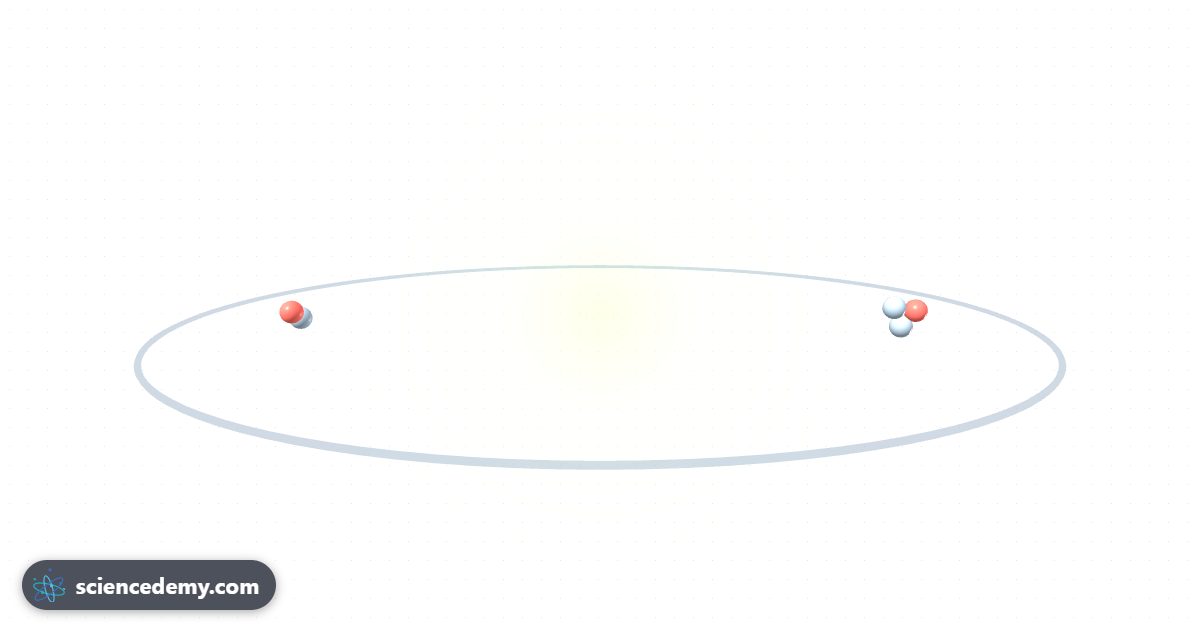
Nuclear fission vs fusion: fission is a heavy atomic nucleus splitting apart into smaller ones, while fusion is two light nuclei joining together into a heavier one. They're opposite processes, but both release huge amounts of energy for the same reason — the resulting nucleus (or nuclei) ends up with very slightly less mass than what went in, and that missing mass reappears as energy following Einstein's E = mc². Fusion is what powers the Sun and every other star, fusing hydrogen into helium in their cores; fission is what powers nuclear power stations on Earth today, splitting uranium or plutonium atoms.
What is nuclear fission vs fusion?
People often mix these up, but they're opposites:
| Nuclear fusion | Nuclear fission | |
|---|---|---|
| What happens | Light nuclei join | A heavy nucleus splits |
| Typical fuel | Hydrogen, deuterium, tritium | Uranium-235, plutonium-239 |
| Triggered by | Extreme heat and pressure | A neutron striking the nucleus |
| Chain reaction? | No — each fusion event is separate | Yes — each split releases neutrons that split more nuclei |
| Where it happens naturally | Stars | Nowhere (it needs a trigger) |
| Waste | Helium (not radioactive) | Long-lived radioactive fragments |
| Used on Earth for power today | Not yet at commercial scale | Yes, in nuclear power stations |
Both release energy because the resulting nucleus or nuclei have less mass than what went in — fusion by combining light nuclei, fission by breaking apart a heavy one. Iron-56 sits at the bottom of the binding-energy curve: fuse anything lighter than iron, or split anything heavier than iron, and you release energy. That's also the answer to which is more powerful — gram for gram, fusion releases about three to four times more energy than fission, because binding energy rises faster near iron for the lightest elements than it falls off for the heaviest ones.
Fission is also a chain reaction: when a uranium-235 nucleus splits, it throws off two or three free neutrons, each of which can strike another uranium nucleus and split that one too. Left unchecked, this multiplies exponentially (an atomic bomb); in a reactor, control rods absorb some neutrons to hold the reaction at a steady, controlled rate instead.
How does nuclear fusion work?
Every atomic nucleus is made of protons and neutrons, held together by the strong nuclear force. That force is enormous, but it only acts over an extremely short range — about the width of a nucleus itself. To fuse two nuclei, you first have to shove them close enough for the strong force to take over, against the far weaker but longer-range push of their matching positive charges.
That's the whole problem of fusion in one sentence: get two positively-charged nuclei close enough, fast enough, that the strong force can grab them before they bounce apart.
Why does fusion release energy?
The product nucleus has slightly less mass than the two nuclei that made it. That missing mass hasn't vanished — it has converted into energy, according to:
E = mc²
where E is energy (joules), m is the mass that disappears (kilograms), and c is the speed of light (3 × 10⁸ m/s). Because c is squared, even a minuscule mass loss produces a vast amount of energy. Fusing just one gram of hydrogen into helium releases roughly as much energy as burning 10 tonnes of coal.
This is different from a chemical reaction, where atoms simply rearrange their outer electrons and the nuclei never change. Fusion changes the nucleus itself, which is why its energy release is roughly a million times larger per kilogram of fuel.
What is the proton-proton chain?
The proton-proton chain is the main fusion pathway inside the Sun, and it happens in stages:
- Two protons (hydrogen-1 nuclei) fuse. One instantly turns into a neutron, releasing a positron and a neutrino. The result is deuterium (hydrogen-2: one proton, one neutron) — this is an isotope of hydrogen, just like the ones covered in what is an isotope.
- The deuterium nucleus fuses with another proton, producing a light helium-3 nucleus (2 protons, 1 neutron) and releasing a gamma ray.
- Two helium-3 nuclei fuse together, forming ordinary helium-4 (2 protons, 2 neutrons) and releasing two spare protons back into the mix.
Across the whole chain, four hydrogen nuclei end up as one helium nucleus, plus a stream of gamma rays, positrons and neutrinos that eventually carry the energy to the Sun's surface as light and heat.
Why is fusion so hard to achieve on Earth?
To overcome the repulsion between nuclei before the strong force can act, the fuel needs to be:
- Extremely hot — around 100–150 million °C, so nuclei collide with enough energy to get close.
- Extremely dense, so collisions happen often enough to matter.
- Confined long enough for fusion to outpace the energy lost to the surroundings.
At those temperatures, matter exists as a plasma — a gas of stripped nuclei and free electrons — which can't simply be held in a container; the walls would vaporise instantly. Reactors instead use powerful magnetic fields (in a doughnut-shaped tokamak) or focused lasers to confine and compress the fuel, usually a mix of deuterium and tritium (hydrogen isotopes), which fuses more easily than ordinary hydrogen. Getting the reaction to release more energy than it consumes — called net energy gain or "ignition" — has only been reached in short laboratory bursts so far, not in a continuously running power plant.
Common mistakes
- Thinking fusion is the same as fission. They're reverse processes with completely different fuels and waste.
- Saying fusion has no waste. It produces no long-lived radioactive waste like fission does, but reactor components do become radioactive from neutron bombardment over time.
- Forgetting the mass loss is tiny but not zero. E = mc² works because c² is a huge number, not because the mass change itself is large.
- Assuming the Sun "burns" hydrogen like a fire. Burning is a chemical reaction between electrons; fusion changes the nucleus — entirely different physics.
Frequently asked questions
What is nuclear fusion in simple terms?
Nuclear fusion is when two light atomic nuclei combine to form one heavier nucleus. The new nucleus has slightly less mass than the two that joined, and that missing mass is released as energy following E = mc². It's the reaction that powers the Sun and all other stars, fusing hydrogen into helium in their cores.
Why don't we have fusion power stations yet?
Fusion needs fuel heated to 100–150 million °C and held densely together long enough for reactions to outpace energy losses — conditions no material container can touch. Reactors confine the superheated plasma with magnetic fields or lasers instead, and keeping that confinement stable while producing more energy than it consumes remains an unsolved engineering challenge, though experimental reactors have reached brief net gains.
Is nuclear fusion safer than nuclear fission?
Fusion carries less long-term risk: it produces no long-lived radioactive waste and cannot run away into a meltdown, because the reaction needs such extreme conditions that it stops the instant confinement is lost. Fission reactors, by contrast, use a self-sustaining chain reaction with uranium or plutonium, which produces radioactive waste that stays dangerous for thousands of years.
What elements can undergo fusion?
Any light element can fuse, but hydrogen isotopes (deuterium and tritium) fuse most easily because their nuclei carry the smallest possible charge, meaning the least repulsion to overcome. Stars heavier than the Sun go on to fuse helium, carbon and other elements later in their lives, building up heavier elements all the way up to iron.
Try it yourself
Open Nuclear Fusion and fire hydrogen isotopes at each other to see the proton-proton chain step by step — watch the mass defect appear as released energy, and compare how much harder it is to fuse heavier nuclei than light ones. For the atomic structure that makes isotopes possible in the first place, see the Atom Builder.
See it for yourself, in 3D and free.
Try it in the Nuclear Fusion