How to Find Electron Configuration (Step by Step)
Write the full electron configuration of any atom with the aufbau order, noble gas shorthand, and the chromium and copper exceptions, plus a worked example.
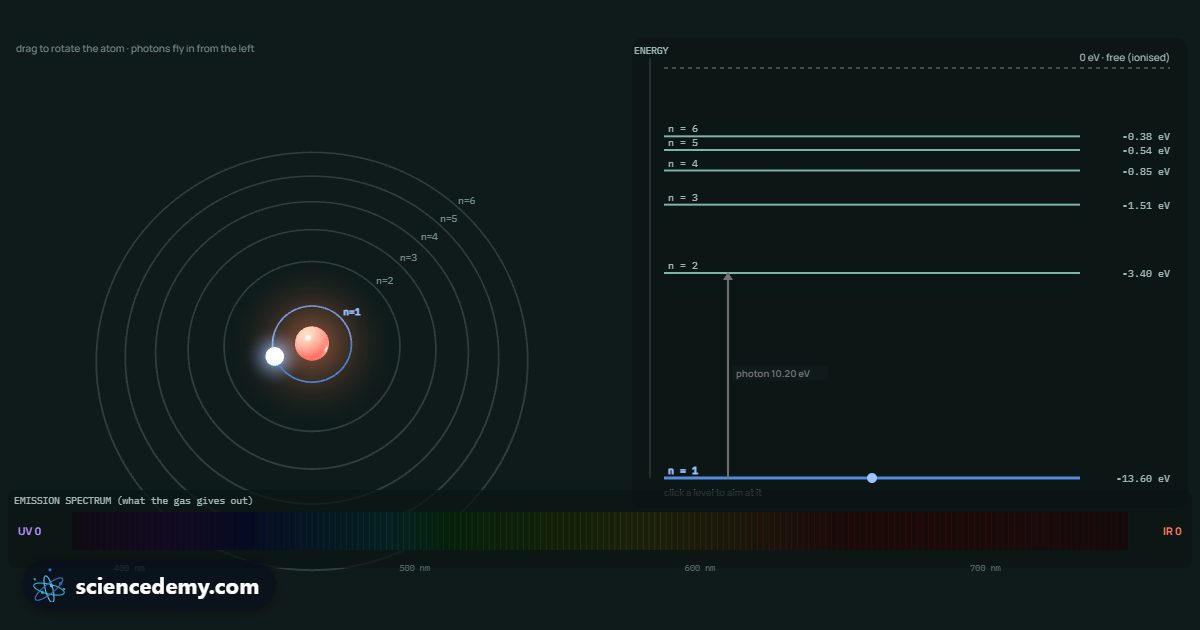
How to find electron configuration: fill the subshells in aufbau order (1s, 2s, 2p, 3s, 3p, 4s, 3d, 4p…), giving each one as many electrons as it can hold, until you run out of electrons. For phosphorus (15 electrons), that is 1s² 2s² 2p⁶ 3s² 3p³ — the superscripts always add up to the atomic number.
What is electron configuration?
An atom's electron configuration is the list of subshells its electrons occupy, written as a shell number, a subshell letter (s, p, d or f) and a superscript for how many electrons are in it. Electrons fill the lowest-energy subshells first, which is why the order jumps around between shells: 4s fills before 3d, for example, even though shell 3 comes before shell 4.
Each subshell holds a fixed maximum number of electrons: s holds 2, p holds 6, d holds 10, and f holds 14. A full configuration is just those subshells filled in order until the electrons run out.
What order do subshells fill in?
This is the aufbau order (German for "building up"), and it is the same for every element. It is also exactly how the electron configuration periodic table is organised: each block of columns (s, p, d, f) fills the matching subshell, so you can read the fill order straight off the table's shape.
| Subshell | Max electrons | Fills after |
|---|---|---|
| 1s | 2 | (first) |
| 2s | 2 | 1s |
| 2p | 6 | 2s |
| 3s | 2 | 2p |
| 3p | 6 | 3s |
| 4s | 2 | 3p |
| 3d | 10 | 4s |
| 4p | 6 | 3d |
| 5s | 2 | 4p |
Notice 4s comes before 3d. This is the single most common point of confusion: shell number alone does not decide fill order. A subshell's energy depends on both the shell number and the subshell type, and 4s happens to be slightly lower in energy than 3d, so it fills first — then empties first too, which is why transition metal ions lose their 4s electrons before their 3d ones.
Worked example: phosphorus
Phosphorus is element 15, so a neutral atom has 15 electrons. Fill subshells in order until they add up to 15:
- 1s² (2 electrons, running total 2)
- 2s² (2, total 4)
- 2p⁶ (6, total 10)
- 3s² (2, total 12)
- 3p³ (3, total 15 — done)
Full configuration: 1s² 2s² 2p⁶ 3s² 3p³. The superscripts (2, 2, 6, 2, 3) add up to 15, which is always a quick way to check your answer. This full form is also called orbital notation, since each subshell is built from individual orbitals (one s orbital, three p orbitals, and so on) that this shorthand doesn't show separately.
A neutral atom in its lowest-energy arrangement, exactly as described above, is its ground state electron configuration — the one this article (and an electron configuration chart) always shows. How to find ground state electron configuration is exactly the aufbau method above: fill the lowest-energy subshells first, with no gaps. Knocking an electron up to a higher, temporarily-empty subshell gives an "excited state" instead, which is unstable and not what you are normally asked to find.
How do you use the noble gas shorthand?
Writing out every inner subshell gets long for bigger atoms, so chemists replace the filled "core" with the symbol of the last noble gas before that element in square brackets. Phosphorus's core is neon's configuration (1s² 2s² 2p⁶), so phosphorus is written [Ne] 3s² 3p³ — only the outer electrons, which is also exactly what matters for valence electrons and bonding.
To use the shorthand: find the noble gas (helium, neon, argon, krypton, xenon or radon) with the highest atomic number below your element, put it in brackets, then continue the aufbau order from there. Iron (26) comes after argon (18), so iron is [Ar] 4s² 3d⁶.
Why do chromium and copper break the pattern?
A handful of elements don't follow the simple aufbau order, because a half-full or completely full d subshell is slightly more stable than the "expected" configuration, so one electron moves from 4s into 3d to reach it:
- Chromium (24): expected [Ar] 4s² 3d⁴, actual [Ar] 4s¹ 3d⁵ (a half-full 3d).
- Copper (29): expected [Ar] 4s² 3d⁹, actual [Ar] 4s¹ 3d¹⁰ (a full 3d).
The same thing happens further down the periodic table with molybdenum, silver, and several other d- and f-block elements, for the same reason: a half-full or full subshell is a small energy bonus that outweighs the usual filling order.
How do you find the electron configuration of an ion?
Start from the neutral atom's configuration, then add electrons for a negative ion or remove them for a positive one. Positive ions always lose their outermost shell electrons first — not necessarily the last subshell written. Iron ([Ar] 4s² 3d⁶) loses its two 4s electrons first to form Fe²⁺ ([Ar] 3d⁶), even though 3d was filled after 4s.
Common mistakes
- Filling 3d before 4s. Shell number is not the same as fill order: 4s has lower energy than 3d and fills first.
- Forgetting the chromium and copper exceptions. [Ar] 4s² 3d⁴ for chromium looks right but is not what a real chromium atom has.
- Removing 3d electrons before 4s when writing an ion. Transition metal ions always lose 4s electrons first.
- Superscripts that don't add up to the atomic number. Always check your total against the element's electron count.
Frequently asked questions
What is the electron configuration of oxygen?
Oxygen (element 8) is 1s² 2s² 2p⁴. The first shell fills with 1s² (2 electrons), then the second shell fills 2s² (2 more, total 4) and finally 2p⁴ (4 more, total 8) — the atomic number.
How do you write electron configuration in noble gas notation?
Find the noble gas with the highest atomic number below your element, write its symbol in square brackets, then continue the aufbau order for the remaining electrons. Sulfur (16) comes after neon (10), so sulfur is [Ne] 3s² 3p⁴ instead of the full 1s² 2s² 2p⁶ 3s² 3p⁴.
Why does 4s fill before 3d?
Because 4s is lower in energy than 3d for the atoms where both are being filled, even though shell 3 comes before shell 4. This is a real result of how electrons interact in a many-electron atom, not just a rule to memorise — but once learned, the aufbau order (1s, 2s, 2p, 3s, 3p, 4s, 3d, 4p…) never changes.
What is the electron configuration of an ion like Fe³⁺?
Start from iron's atom configuration, [Ar] 4s² 3d⁶, and remove 3 electrons from the outermost shell first: both 4s electrons, then one from 3d, giving [Ar] 3d⁵. This is why iron's ions (Fe²⁺ and Fe³⁺) are both written with only 3d electrons beyond the argon core, never with any left in 4s.
Try it yourself
Open the Electron Lab and fire photons at different atoms to watch electrons jump between real shells and subshells, one energy level at a time. Build any atom in the Atom Builder and watch its shells fill in the same aufbau order used above. Once you have the full configuration, see how to find valence electrons from it — just add up the electrons in the highest shell number.
See it for yourself, in 3D and free.
Try it in the Electron Lab