Parts of a Volcano: Labelled Diagram and How It Erupts
The parts of a volcano are the magma chamber, main vent, crater, cone and side vents. See what each part does, the three types of volcano and why some erupt violently.
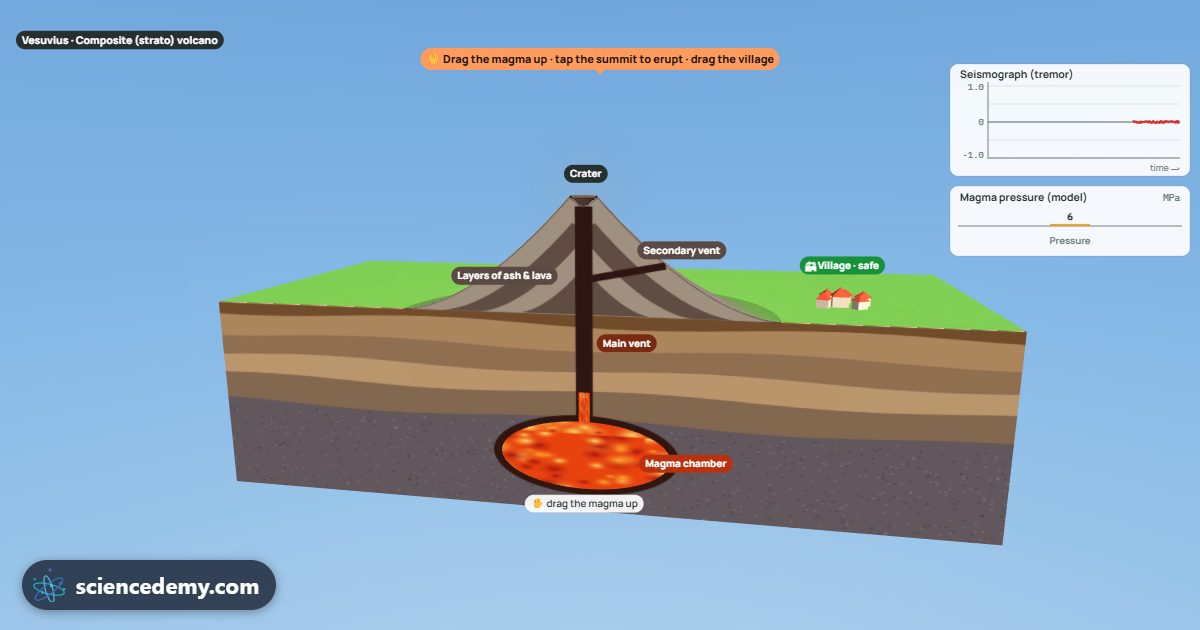
The main parts of a volcano are the magma chamber (a store of molten rock deep underground), the main vent or conduit (the pipe magma rises through), the crater at the top, the cone built from layers of old lava and ash, and side vents that branch off the conduit. When pressure in the magma chamber grows too high, magma forces its way up the vent and erupts as lava, ash and gas.
What are the parts of a volcano and their functions?
Each part has a job in getting molten rock from deep inside the Earth to the surface. Reading a labelled diagram from the bottom up follows the path the magma takes.
| Part | What it is | What it does |
|---|---|---|
| Magma chamber | A pool of molten rock 1–10 km below the surface | Stores magma and builds up pressure |
| Main vent (conduit) | A pipe through the crust | Carries magma up to the surface |
| Side (secondary) vent | A branch off the main vent | Lets magma escape from the side of the volcano |
| Crater | A bowl-shaped hollow at the summit | Where the main vent opens out |
| Cone | Layers of cooled lava, ash and rock | The mountain itself, built up eruption after eruption |
| Ash cloud | Tiny pieces of shattered rock and glass | Carried by the wind, can fall hundreds of kilometres away |
| Lava flow | Molten rock running over the surface | Spreads out and cools into new rock |
Magma vs lava
Magma is molten rock while it is still underground. Once it reaches the surface it is called lava. It is the same material: only its position has changed. Magma also carries dissolved gas, mostly water vapour, carbon dioxide and sulfur dioxide, held in the liquid by the pressure of the rock above, much like the gas in a sealed fizzy drink.
Crater vs caldera
A crater is the small hollow over the vent. A caldera is far bigger, often several kilometres across, and forms when a huge eruption empties the magma chamber and the summit collapses into the space left behind.
How do volcanoes erupt?
Volcanoes erupt when magma is pushed up because it is less dense than the solid rock around it and because the gas inside it expands. The process happens in four steps:
- Rock in the mantle partly melts, usually at a plate boundary or a hot spot, and the magma rises because it is less dense.
- Magma collects in the magma chamber, and more arriving from below raises the pressure.
- As magma rises, the pressure on it falls, so dissolved gas comes out as bubbles, which expand and drive the magma upwards faster.
- When the pressure is greater than the strength of the rock above, the magma breaks through the vent and erupts.
Why are some eruptions explosive?
How violent an eruption is depends mostly on the magma's viscosity (how sticky it is), and viscosity depends on its silica content. Runny, low-silica basalt lets gas bubbles escape gently, giving effusive eruptions with flowing lava. Sticky, high-silica magma traps the gas until the pressure is enormous, then it shatters into ash and pumice in an explosive eruption. The most dangerous result is a pyroclastic flow: a cloud of hot ash and gas that races down the slope at over 100 km/h.
What are the types of volcanoes?
There are three main types of volcanoes, and their shape comes straight from the kind of magma they erupt.
| Type | Magma | Shape | Eruptions | Example |
|---|---|---|---|---|
| Shield volcano | Runny, low silica | Wide, gentle slopes | Gentle lava flows | Mauna Loa, Hawaii (4,169 m) |
| Composite (strato) volcano | Sticky, high silica | Tall, steep cone of ash and lava layers | Explosive | Mount Fuji, Japan (3,776 m) |
| Cinder cone | Gas-rich, medium | Small, steep cone of loose cinders | Short-lived fountains of lava | Parícutin, Mexico (1943–52) |
Shield volcanoes are the largest by volume: Mauna Loa rises 4,169 m above sea level and even further from the sea floor, built from thousands of thin lava flows. Composite volcanoes form at destructive plate boundaries, where one plate sinks under another (see types of plate boundaries). Cinder cones can grow very fast: Parícutin appeared in a Mexican cornfield in 1943 and kept erupting until 1952.
How is the size of an eruption measured?
The volcanic explosivity index (VEI) rates eruptions from 0 to 8, based mainly on how much material is thrown out and how high the eruption column rises. Each step up the scale is about ten times more erupted material.
- VEI 0–1: gentle, like the lava flows of Hawaiian shield volcanoes.
- VEI 5: Vesuvius in AD 79, which buried Pompeii and Herculaneum, and Mount St Helens in 1980, which blew off its north side.
- VEI 8: "supervolcano" eruptions of more than 1,000 km³ of material, which happen only tens of thousands of years apart.
Common mistakes
- Calling it lava underground. Underground it is magma; it is only lava at the surface.
- Thinking all volcanoes are cone-shaped mountains. Shield volcanoes are so wide and flat they can look like gentle hills.
- Saying the lava is the biggest danger. Most deaths come from pyroclastic flows, ash and mudflows (lahars), not lava, which usually moves slowly enough to walk away from.
- Mixing up the crater and the magma chamber. The crater is at the top; the chamber is kilometres down.
Frequently asked questions
What are the 5 main parts of a volcano?
The five main parts of a volcano are the magma chamber, the main vent, the crater, the cone and the side vents. The magma chamber stores molten rock underground. The main vent is the pipe it rises through, opening at the crater on top. The cone is the mountain built from layers of old lava and ash, and side vents are branches that let magma out on the flanks. Diagrams often add the ash cloud and lava flow too.
What causes a volcano to erupt?
A volcano erupts when pressure in the magma chamber becomes greater than the strength of the rock holding it in. Magma rises because it is less dense than solid rock, and as it rises, gas dissolved in it forms bubbles that expand and push it up faster. Fresh magma arriving from below adds more pressure. When the rock finally breaks, magma, gas and ash burst out through the vent.
Which type of volcano is the most dangerous?
Composite (strato) volcanoes are usually the most dangerous. Their sticky, high-silica magma traps gas until it explodes, producing ash clouds and pyroclastic flows that travel far faster than people can run. Vesuvius and Mount St Helens are both composite volcanoes. Shield volcanoes such as Mauna Loa erupt runny lava more gently, so they damage property but rarely cause many deaths.
What is the difference between an active, dormant and extinct volcano?
An active volcano is erupting now or has erupted in recent history, usually the last 10,000 years. A dormant volcano has not erupted for a long time but still has a magma supply and could erupt again. An extinct volcano is not expected to erupt again because it has been cut off from its magma source. The line between dormant and extinct is hard to draw: some "extinct" volcanoes have surprised scientists.
Try it yourself
Open the 3D volcano tool and switch on Labels to see every part of the volcano in a cut-away view. Pick a shield volcano, then raise the Silica (stickiness) and Dissolved gas sliders and press 🌋 Erupt to watch a gentle lava flow turn into an explosive ash eruption. Try Vesuvius and Mount St Helens to compare a VEI 5 eruption with Mauna Loa, and drag the village to see where the ash falls with the wind. Then follow the water that falls as rain on the slopes in the water cycle tool, or see where volcanoes form in the plate tectonics tool.
See it for yourself, in 3D and free.
Try it in the Volcano